Blog

  • Hiring Flat for 2026 Grads

    Hiring Flat for 2026 Grads

    fizkes/iStock/Getty Images Plus

    Forty-five percent of employers consider the job market to be “fair,” and they are projecting a 1.6 percent year-over-year increase in hiring for the Class of 2026, according to a new report from the National Association of Colleges and Employers.

    The last time a plurality of employers gave the job market a “fair” rating was in 2021, when hiring projections were also flat. During the four interim years, most employers rated the job market as “good” or “very good,” the report shows.

    About 60 percent of the 183 employers NACE polled for the 2026 Job Outlook Survey said they are planning to keep the number of people they hire stable next year. A quarter of employers said they plan to increase the number of hires, primarily citing a commitment to succession planning and the talent pipeline, as well as company growth, as key reasons. The top five industries for projected hiring growth are miscellaneous professional services; engineering services; construction; finance, insurance and real estate; and management consulting.

    About 14 percent of employers said they plan to decrease the number of people they hire next year, citing reductions in business needs and projects, an uncertain economy and budget cuts. These employers are primarily concentrated in the chemical pharmaceutical manufacturing, transportation, wholesale trade, food and beverage manufacturing, and miscellaneous manufacturing industries.

    NACE surveyed employers between Aug. 7 and Sept. 22 of this year for their thoughts on the job market, hiring trends and salaries. About 40 percent of employers plan to increase salaries for bachelor’s degree holders in 2026, and 28.3 percent will do the same for master’s degree holders. No employers reported plans to decrease salaries for either group next year, the report states.

    Skills-based hiring remains popular—69.5 percent of employers reported they use the approach. Asked how students can best prepare for a skills-based hiring process, employers primarily said applicants should “prepare for interviews that demonstrate their skills,” “participate in experiential learning or work during college” and “translate college coursework into a skills language.”

    Meanwhile, fewer employers care about applicants’ GPAs—only 42.1 percent of employers plan to screen GPAs in 2026, compared with 73.3 percent in 2019. Academic majors, industry experience and internships, and internships at the employer’s organization are top decision-making factors for employers that don’t screen for GPAs.

    Artificial intelligence is also top of mind, but many employers are still figuring out exactly how AI will integrate into their business, said Christine Cruzvergara, chief education strategy officer at the job and internship platform Handshake. NACE data reflects a similar sentiment toward AI among employers—nearly 59 percent said they are not planning to or unsure whether they’ll augment entry-level jobs with AI, and 25 percent said they’re currently discussing it. About 13 percent of jobs require AI skills, the report shows, and 10.5 percent of entry-level jobs include AI in their descriptions.

    “I think the majority of employers are still experimenting with how AI will supplement or augment the work that their employees are doing from entry level all the way to more senior folks,” Cruzvergara said. “And I think some functions have probably already started to figure that out a little bit more, like in some of the technical roles, or marketing is another big one, versus customer success or some of the other types of roles that people have. It’s a varied spectrum that you’re seeing at the moment.”

    The percentage of fully hybrid jobs has declined since spring 2025, from 47 percent to 42 percent, while the percentage of fully in-person jobs increased from 43 percent to 48 percent, the report shows. The percentage of fully remote jobs has held steady at 10 percent. More entry-level jobs are fully in-person—50 percent—and fewer are fully remote, 6 percent.

    Ashley Mowreader contributed to this report.

    Source link

  • International Students Deserve Better (opinion)

    International Students Deserve Better (opinion)

    I recently caught up with a former student pursuing her doctorate. Her project is timely. She is Cameroonian and a legal resident in the United States studying how pro-democracy movements succeed or how and when they fail. Students like her benefit our nation’s economy and our global ability to promote democracy and peace at home and abroad.

    As she and I chatted, I detected exhaustion in her voice. I asked her how she is holding up. She replied with unmistakable sadness: “In Cameroon, I felt like my voice was stifled. I thought I could finally use my voice in the United States. I no longer feel that way.”

    As a current international student, she lives in constant fear. Campus administrators have cautioned her against speeding or driving with a broken taillight. Her faculty adviser serves as her emergency contact if she is detained by federal immigration authorities.

    The extraordinary crackdown on international students enrolled at U.S. universities, including the more than 400 students in my state of Texas alone who learned that their visa status had been canceled in spring of 2025, has little precedent in recent history. While officials in Washington restored students’ visa statuses in response to court rulings, the Department of State has begun reviewing visa applicants’ social media accounts “for any indications of hostility towards the citizens, culture, government, institutions or founding principles of the United States.”

    As a university instructor, my classes have been enriched by the perspectives of international students. But their benefit to this country extends beyond their academic participation. Each year, upwards of 150,000 college-age youth participate in the little-known low-wage employment-based categories of the J-1 visa, including the Summer Work Travel, trainee, intern and au pair programs. Participants work in low-wage jobs at restaurants, in hotels and in homes providing live-in day care for thousands of American families.

    The J-1 Exchange Visitor Program began with modest enrollment in the 1960s to promote Cold War–era public diplomacy. But numbers have grown in recent decades, transforming these employment-based categories into a significant stream of temporary foreign workers. A major draw is the low cost of employing them. Employers avoid most payroll taxes and sidestep bureaucratic red tape. Since the State Department oversees the program, there is no labor market testing or commitment to public data as is standard with Department of Labor foreign worker programs.

    My multiyear findings and those of others—including the findings from a recent investigation by The New York Times—illuminate several J-1 program shortcomings: fraud in recruitment, inadequate and overpriced housing, and a failure of the State Department and designated cultural sponsors to address reports of abuse. In practice, sponsors amount to labor brokers who collect $1,000 to $5,000 to match a J-1 participant with an employer. I will never forget the Peruvian Summer Work Travel participant who wept as he described losing his job and housing amid COVID shutdowns. Neither his employer nor sponsor came to his aid. Instead, the Peruvian consulate sheltered and fed him until he found a way home. What his experience made clear to me was how weak J-1 protections are and how, amid a crisis like COVID, instead of building bonds of international friendship and goodwill, his J-1 cultural sponsor host and employer abandoned him in a crucial time of need.

    Similarly, the demand for work authorization through the Optional Practical Training program, available to international students here on the F-1 visa, has skyrocketed, growing from 154,522 in 2007 to 418,781 in 2024. Like for J-1 visas, the Labor Department has no formal regulatory role over the OPT program, which instead is administered by the Department of Homeland Security. The OPT program originated in 1992 as a pilot initiative, and after intensive corporate lobbying, the government tripled the maximum duration of the program.

    The resulting problems with the OPT program are obvious and preventable. Journalists and scholars have documented unchecked and underregulated growth, sham employment offers, and systematic underpayment, along with the proliferation of so-called body shops, staffing agencies that hire foreign workers and then rent them out to big-name tech firms—often at bargain-basement rates.

    Undoubtedly, the risks faced by international students on campus versus at work differ substantially. So do their causes: The threat to international students on campus results from a hard political turn against immigration in rhetoric and policy and an effort to censor free speech in higher education. The risks faced by J-1 and F-1/OPT workers stem from the ongoing demand among U.S. employers for cheap, compliant migrant workers. Yet, Congress legislated pathways for both to promote democracy and global understanding between U.S. and foreign citizens, aims from which we have drastically strayed.

    Prohibiting J-1 recruitment fees, shifting oversight of J-1 and OPT programs to the Labor Department, and making available comprehensive labor data for both would result in far better treatment and stewardship of international youth and more fairness to U.S. workers. It would also shed light on the opaque inner workings of U.S. temporary migrant worker policy at a time when mass deportation and the gutting of temporary protected status and refugee programs only heighten demand for new sources of low-priced and flexible labor, labor that immigrant populations have long been called upon by U.S. employers to do.

    Cate Bowman is an associate professor of sociology at Austin College, specializing in immigration and labor issues.

    Source link

  • Managing Change Is a Skill; Here’s How to Teach It (opinion)

    Managing Change Is a Skill; Here’s How to Teach It (opinion)

    In every sector, including higher education, change has become the defining condition of professional life. Budgets shift, opportunities change, teams reorganize and expectations evolve faster than most of us can keep up. Students, postdocs and seasoned professionals alike are being asked to adapt constantly, often without ever being taught how to do it.

    As directors of career centers, our job is to spot the skills tomorrow’s leaders will need and to design ways to help them build those skills now. At the top of that list is the ability to navigate change and to help others do the same. It’s not a “nice-to-have” skill anymore; it’s part of how one leads, collaborates and makes their own work sustainable.

    We’ve been discussing how to help trainees and professional colleagues negotiate change for a long time. Naledi developed the Straight A’s for Change Management framework through National Science Foundation–funded work focused on training biomedical professionals in people management and managing-up skills. Dinuka has used this approach in his own leadership practice and integrated its lessons into his work supporting trainees and professionals. Together, we wanted to share what this looks like in real life.

    What’s often missing in professional skill development isn’t the outcome; it’s the process. The Straight A’s for Change Management framework offers exactly that. Built on four steps—acknowledge and accept, assess, address, and appreciate achievement—it helps people build agency: the capacity to act skillfully even when they can’t control external events.

    Acknowledge and Accept

    Step one is to acknowledge reality and then accept what it means to and for you.

    Many people we work with, from first-year students to senior leaders, stop short of even this first step. They can acknowledge the problem—funding has been cut, hiring has slowed or their people are struggling with change—but they don’t take the harder step of acceptance.

    Acceptance means internalizing that your long-standing plan or approach may no longer be viable and that you will need to adjust your goals or strategies. It can also mean accepting that you might need support or community beyond your institution to help hold this heavy truth. But this is the inflection point where agency begins: not wishing conditions were different, but accepting the need for you to think and act differently, too.

    For a postdoc, acceptance might mean recognizing that a principal investigator’s funding constraints could shorten the timeline of their project. That realization could prompt them to seek alternative support, accelerate a job search or pivot their research scope. For a student, acceptance might mean realizing that since their adviser’s experience is limited to academic careers, they will need to proactively seek additional mentorship to position themselves for biotech careers.

    For Dinuka, acceptance came during a period of leadership transition. The role he had taken on had quietly shifted beneath him—new expectations, new reporting lines and values that no longer aligned with what drew him to the work in the first place. He agonized over whether to stay and adapt or to acknowledge that something essential had changed. The moment he admitted that reality, uncomfortable as it was, he could finally see a path forward. Acceptance meant reclaiming his agency.

    Reflection Prompts:

    • What change in your environment are you resisting acknowledging?
    • What might acceptance make possible that resistance is currently blocking?
    • Who can help you process this shift with honesty and perspective?

    Assess the Change

    Once you’ve acknowledged and accepted a situation, the next step is to assess it strategically. This is where you shift from emotional reaction to analytical clarity.

    A useful tool here is a SWOT analysis (strengths, weaknesses, opportunities, threats). Ask yourself:

    • Strengths: What are your skills? Where can you leverage them in this situation?
    • Weaknesses: Where are you vulnerable?
    • Opportunities: What new directions might this open?
    • Threats: What could block your goals?

    Answering these questions encourages balance. Some start with weaknesses and threats; others begin with strengths and opportunities. What matters is that you consider all four dimensions.

    It’s also helpful to share your SWOT with a mentor or trusted colleague. Instead of laying out your situation and asking, “What should I do?” you can say, “Here’s how I’m assessing my situation. Can you help me identify what I might be missing?” Tools like a SWOT provide structure for both your reflection and your conversations with those who support you.

    When Dinuka reached this stage, he turned to trusted mentors, colleagues and family members to triangulate perspectives. His SWOT involved asking, what strengths could he draw on if he stayed? Where were the risks if he left? What opportunities might emerge if he stepped away? What threats might come from doing so? Speaking these questions aloud prevented him from getting stuck in his own echo chamber and restored clarity. Assessment gave his uncertainty a shape.

    Reflection Prompts:

    • How fully have you mapped the situation you’re in—emotionally and strategically?
    • Which perspective (strengths, weaknesses, opportunities, threats) do you tend to overemphasize or neglect?
    • Who could provide an outside view to help you see what you might be missing (trusted mentors, colleagues, friends or family members)?

    Address the Change

    To address change is to use what you’ve learned to respond skillfully.

    Sometimes it starts by envisioning your best possible outcome six to 12 months out and working backward from there. Other times it means short-term triage, only figuring out the next logical step rather than solving everything at once. That might mean updating your CV, signing up for job boards or reaching out to a mentor.

    One postdoc Naledi worked with wanted to keep his career options open. In response, he began carving out one hour a week to set up informational interviews with alumni in biotech and communication careers, learning which skills were in demand. With that insight, he added a side project that strengthened his technical skills, focused on service and leadership opportunities to communicate science, and kept his network apprised of his progress.

    In Dinuka’s case, addressing the change meant testing what was still possible before making a decision. He clarified expectations with new leadership, re-aligned priorities and gave the situation space to evolve. When it became clear that the trajectory no longer matched his values or goals, he made the intentional choice to step away. That decision, though difficult, came from a place of calm rather than crisis.

    Addressing change when the future is unclear means shifting from awareness to iterative forward motion, using your definition of integrity as your compass.

    Reflection Prompts:

    • What is one small, concrete step you can take this week to move forward?
    • If you imagine the best version of this situation a year from now, what would need to happen between now and then?
    • How can you act with integrity even when you can’t control outcomes?

    Appreciate Achievements

    The final step, often overlooked, is to appreciate achievements. Many wait for a situation to resolve before celebrating. But change often unfolds over a long arc, and there may never be a moment when everything “returns to normal.”

    That means recognizing that even small wins are a big deal. Did you talk to a friend to process your situation? Celebrate. Did you update your CV? Celebrate. Did you gain greater clarity about your direction? Celebrate!

    Shifting from celebrating only outcomes (a publication, a job offer, a raise) to also celebrating progress, milestones and effort helps sustain momentum and motivation.

    When Dinuka finally left that role, he felt grounded. He appreciated the mentors who guided him, the colleagues who supported him and the lessons learned in difficulty. He celebrated not the exit itself, but the growth that came with it. That sense of gratitude transformed what could have been resentment into renewal.

    Appreciating achievements is not self-indulgent; it is strategic. It focuses attention on what you have accomplished despite uncertainty, which builds confidence to keep going.

    Reflection Prompts:

    • What progress have you made in the past month that you haven’t acknowledged?
    • Whom can you thank or recognize for supporting your journey through change?
    • How do you remind yourself that growth often looks like struggle before success?

    Why Straight A’s Matter

    Taken together, the A’s—acknowledge and accept, assess, address and appreciate achievement—form a road map for agency. We may not control personal setbacks, professional disappointments, shifting organizational priorities, unfair practices or political turbulence. But with every new challenge, we can start responding intentionally, identifying where we can still move.

    Our experiences reinforced that agency is learned through practice. The Straight A’s provide both structure and language for something many of us attempt intuitively: turning uncertainty into direction. The framework accepts complexity and teaches us to meet it with clarity and integrity.

    By practicing the Straight A’s, we build the muscles of agency and leadership. If we teach the next generation of leaders these approaches as part of their training and development, they will be prepared to lead skillfully in a world where the only constant is change.

    Naledi Saul is director of the Office of Career and Professional Development at the University of California, San Francisco, She coaches and frequently presents on people management and managing-up skills for higher education and biomedical audiences.

    Dinuka Gunaratne (he/him) has worked across several postsecondary institutions in Canada and the U.S. and is a member of several organizational boards, including Co-operative Education and Work-Integrated Learning Canada, CERIC—Advancing Career Development in Canada, and the leadership team of the Administrators in Graduate and Professional Student Services knowledge community with NASPA: Student Affairs Administrators in Higher Education.

    They are both members of the Graduate Career Consortium, an organization that provides an international voice for graduate-level career and professional development leaders.


    Source link

  • 3 Steps for Re-Enrolling Adult Learners (opinion)

    3 Steps for Re-Enrolling Adult Learners (opinion)

    About 3.8 million new high school graduates are expected to enroll in higher education next fall. The number of former students with some college credits but no credential is, at nearly 38 million working-age American adults, 10 times larger. If institutions could re-engage just 1 percent of the some college, no credential (SCNC) learners, they would net nearly 400,000 additional enrollments.

    Stopped-out learners represent an enormous market—and colleges should be competing for them. But these former students and other adult learners require much different approaches from a postsecondary institution than do 18-year-olds straight out of high school. Here are three simple actions institutions can take to connect with adult learners and put them on a more direct path to enroll.

    Start With Your Own Stopped-Out Students

    The fiercely competitive market for adult students is dominated by national online universities that pump millions of dollars each year into sophisticated marketing campaigns. That makes it difficult for traditional colleges to make inroads with adult learners. But traditional institutions have a leg up on one subset of adult learners: their own former students.

    These students know their institutions. They might remember some classmates, professors or classes they took. And they probably still live nearby—if not in the same community, then in the same state.

    Institutions unsure about enrolling these students should look at the examples set by other nearby and national colleges that are successfully re-enrolling their own stop-outs. More likely than not, they’re emphasizing what they can do specifically for adult learners and offering a rapid and simplified admissions process. Successful institutions also apply credit for prior learning before a learner re-enrolls and can tell incoming students exactly how long a program will take and how much it costs. Institutions that can convince their former students to re-enroll can increase the odds of attracting other adults with no connection to the institution.

    Make It Easier for Former Students to Enroll

    Colleges should configure the re-enrollment process to address the particular situations of stopped-out students. That means colleges should map the start-to-finish re-enrollment process for stopped-out students just like they have for their first-time, first-year students, and then streamline it to meet the needs of returning adult learners. One key place to begin is identifying the academic, financial or procedural barriers that prevent adult learners from re-enrolling and then communicating options for remediation.

    Before students begin classes, institutions should be ready to illustrate the most direct pathway for students to complete a credential, one that accommodates the complicated lives of time-crunched adult learners and leads to a postgraduation job in a high-demand, high-paying field. Institutions should clarify pathways and credit requirements for learners looking to change from their original major.

    Institutions should also consider devoting a section of their website to their own stopped-out students. That webpage should contain detailed re-enrollment information tailored to the specific needs and support services that can assist with the transition back to college.

    Assist Them Financially

    Here’s a quiz for institutions: How does your tuition discount rate for re-enrolling students compare to that for first-time students? Chances are, it’s extremely low relative to other enrollment segments.

    Unlike first-time, first-year students, adult learners are financially independent and must squeeze college expenses into already tight household budgets. Even a small increase in the discount rate for returning learners can increase the likelihood that they’ll re-enroll. Even better, calling it an “academic scholarship” confers prestige on the recipient and can give a stopped-out student the boost they need to come back strong.

    If stopped-out students have outstanding balances from their previous enrollment, consider reducing or waiving those unpaid fees to eliminate one more barrier to re-enrollment. For institutions that spend millions of dollars annually to recruit and retain traditional-age students, small-dollar investments in adult learners can pay big enrollment dividends.

    Adult learners and stopped-out students are no longer a niche population in the higher education ecosystem, and the data suggests that they’re a worthwhile investment for institutions concerned about evolving demographics, enrollment cliffs and their precarious bottom lines. If institutions can reconnect with their own stopped-out students, make it easier for them to enroll and provide some financial assistance, they can begin to bring back more of these learners and stand a little taller in the crowded higher education marketplace.

    Scott Lomas is the chief strategy officer for ReUp Education.

    Source link

  • Why institutions must protect personal academic tutoring at all costs

    Why institutions must protect personal academic tutoring at all costs

    Join HEPI for a webinar on Thursday 11 December 2025 from 10am to 11am to discuss how universities can strengthen the student voice in governance to mark the launch of our upcoming report, Rethinking the Student Voice. Sign up now to hear our speakers explore the key questions.

    This blog was kindly authored by Dr Gary Jones, Dean of Student Success and Experience, Scholars School System, Dr Steve Briggs, Director of Learning, Teaching and Libraries, University of Bedfordshire, Professor Graeme Pedlingham, Deputy Pro-Vice Chancellor for Student Experience, University of Sussex, Dr David Grey, UKAT Chief Executive Officer and Professor Abigail Moriarty, Pro Vice-Chancellor Education & Students, University of Lincoln.

    A recent analytic induction study (Grey & Bailey, 2020) defined personal academic tutoring in UK higher education as a “proactive, professional relationship between student and tutor sustained throughout the entire student journey.” This partnership involves “dialogue, metacognition, and a structured programme of activities” aimed at fostering student agency, self-efficacy, independent learning, and career and future goals.

    Personal academic tutors play a crucial role by supporting students to “assimilate to the university environment”, facilitating learning and decision-making, reviewing progress, and providing essential information. They enhance both academic ability and emotional well-being through holistic support during one-to-one or group meetings at key academic moments. Personal academic tutors are described as “knowledgeable, approachable, helpful, patient, caring, reliable and non-judgmental” staff members who possess the skills to actively listen, instruct, and advise. They play a crucial role in supporting student success and outcomes.

    HE size and shape is changing

    The increasingly perilous position of economic sustainability in the UK higher education sector has meant that a growing number of institutions are instigating reviews of their ‘size and shape’. In turn, many providers face some tough decisions around what should be prioritised. We anticipate that multiple university senior leadership teams may review academic workload plan allocations during the 2025/26 academic year to ensure that academic staff time can be optimised. As such, consideration may be given to changing time allocations to prioritise teaching preparation and delivery, assessment, and research over personal academic tutoring. We argue that teaching and research should not be treated as more important than personal academic tutoring when allocating time. Nor should teaching and research time be reduced in favour of personal academic tutoring. Rather, we argue for equivalency and that time allocation for personal academic tutoring is an activity institutions should seek to protect, not cut. 

    The value of university education has become a sharper and often more critical question in media narratives, as well as for people considering studying in higher education. With the increasing cost of living and studying at university, the question of how universities can make the benefits to students as visible as possible is understandably at the forefront of many of our minds. We argue that personal academic tutoring is a critical part of achieving this through a strategic, purposeful, proactive, and student-centred approach that is informed by data rather than risking falling into a reactive approach.

    The impact and benefit of personal academic tutoring

    Personal academic tutoring plays a fundamental role in enhancing attainment and impacts the Office for Students’ metrics, which determine institutional success (such as the Teaching Excellence Framework, National Student Survey and Postgraduate Taught Experience Survey). Effective tutoring can be measured in many ways, but not least of these is the positive benefits for helping students to stay on course and be successful, directly supporting those key B3 continuation and completion rates. Effective personal academic tutoring is therefore a virtuous circle for improving student outcomes and experience, and can help give direct evidence of value to both current students and potential applicants.

    Meaningful individualised relationships that encompass the entirety of a student’s learning journey are fostered through effective personal academic tutoring.  Successful tutors nurture a sense of belonging and mattering, aid in navigating the complexities of the higher education study experience, cultivate vital analytical and transferable skills, and impact student career aspirations and employability. At its best, personal academic tutoring transcends traditional teaching methods by facilitating purposeful, structured interactions outside of learning, empowering student agency and promoting the holistic development of all students. As highlighted by NACADA, teaching beyond the curriculum and discipline can help to bring together and contextualise students’ educational experiences in terms of extending aspirations, abilities and lives beyond campus boundaries and timeframes.  

    Academic workload planning and personal academic tutoring

    A recent UKAT senior leaders’ network group meeting provided a forum for discussions regarding allocating dedicated resources for personal academic tutoring in universities. Here, we explored the variation and inconsistencies across the sector regarding how universities operate their personal academic tutoring in terms of academic workload planning. Members reported that across institutions, resource allocation was often determined locally but was driven by central university policy. As the group engaged in thought-provoking dialogue, a critical question emerged: If we genuinely value the importance of learning beyond the traditional subject curriculum, why is personal academic tutoring often not prioritised to the same extent as other activities in the initial stages of academic workload allocation?

    The case for a personal academic tutoring first mindset

    Recognising there are institutional differences, possible common ways of addressing this challenge were discussed, considering the aforementioned financial constraints facing the HE sector. Abi presented to attendees a cup metaphor for academic workload planning based on her previous work. This suggests that, given the significance of personal academic tutoring on student outcomes, personal academic tutoring time should be the first thing built into an academic’s workload plan. She noted, however, that this is often not the case and time allocation for personal academic tutoring may be the last thing added into the workload ‘cup’ (behind teaching, assessment and research), in turn causing the cup to overflow and damaging the significance associated with personal academic tutoring. There was an overwhelming consensus that we should all adopt a personal academic tutoring first ethos in terms of academic workload planning. Accordingly, we encourage readers who will be undertaking academic workload plan reviews over the coming months to reflect on how they allocate personal academic tutoring time, particularly if personal academic tutoring has not historically been the first pour into the workload cup.

    Source link

  • College students are tired of being told that we ‘should be grateful’ for our internships. We also want to get paid

    College students are tired of being told that we ‘should be grateful’ for our internships. We also want to get paid

    by Savannah Celeste Scott, The Hechinger Report
    November 17, 2025

    Imagine clocking out of an eight-hour shift and your compensation is a pat on the back and experience for your resume.  

    This scenario is a disturbing reality for around one million college students, and it needs to stop. Students work countless hours on top of their academic pursuits only to be told they should be “grateful for the opportunity.”  

    The government must pass legislation mandating that all internships include monetary compensation; employers must stop exploiting students and recent graduates while they build necessary work experience.  

    The idea of an unpaid internship is odd considering that most of us grew up learning that work is rewarded. Some 71 percent of American households give children ages 5 to 17 an allowance for doing their chores, a Wells Fargo study found.  

    Practices like that have led many of us to believe that labor should be paid, and it should be no different when we enter the job market.  

    Related: Interested in innovations in higher education? Subscribe to our free biweekly higher education newsletter.  

    There is a disturbing correlation between unpaid internships and exploitation, especially for people from marginalized communities. Historically, Black people have been the face of working without compensation — a phenomenon dating back to early American slave practices.  

    Unpaid work is not just exploitation — it is dehumanizing. No person can survive without money, so no one should be required to work with no compensation to help them live. The reality is that, unlike higher-income students, low-income students cannot afford to work for free. They need money to cover their tuition, afford groceries and pay for a place to live. This is why unpaid internships further the cycle of economic exploitation, the student-run Columbia Spectator noted.  

    Yet there are plenty of people who believe compensation does not always have to be monetary. Many students have heard employers extol the value of “experience” as they try to persuade them to work without pay.  

    Such was the case for me when I was hired for a legal internship as a freshman in college. I thoroughly enjoyed my internship, as it gave me both professional and social opportunities. But it was an extremely difficult time for me both mentally and financially.  

    I was taking 16 credit hours, regularly writing for a student publication and working another part-time job to save money for law school. The stress of going into the office every day to handle casework — often ranging from domestic violence to sexual assault cases — was mentally taxing when combined with schoolwork and extracurricular responsibilities.  

    While the experience that the internship provided was incredible, monetary compensation would have made it much less stressful, as I would not have needed the other job.  

    Unpaid internships can also hurt graduates’ prospects in the job market. Those who have had unpaid internships receive fewer job offers on average than those who completed paid internships, statistics from the National Association of Colleges and Employers (NACE) show.  

    The average student who completed an unpaid internship also saw $22,500 less in their starting salaries than those who completed paid internships. According to the Delta Institute, “employers offering compensation tend to invest more in mentoring, performance feedback, and skill-building”; that added investment provides students with more preparation for the job market and helps them look more impressive to an employer.  

    Related: Looking for internships? They are in short supply 

    Unpaid interns have been fighting for compensation for decades. A lawsuit filed by two interns against Fox Searchlight over their lack of compensation when working on the movie “Black Swan” resulted in a legal battle that lasted five years. The two interns were finally compensated a total of $13,500 for their work — despite the film grossing more than $300 million.  

    The Fox Searchlight lawsuit sparked a wave of other impassioned interns to plead their cases as well, including a class-action lawsuit against NBCUniversal back in July 2013. That resulted in a $6.4 million settlement split among thousands of interns.  

    In both cases, the employers made millions of dollars in profits but still refused to pay their interns until they were legally forced to do so.  

    According to Shawn VanDerziel, the president and chief executive officer of NACE, paid internships are a “game changer” to employers and employees alike. The dilemma is this: Employers want labor, and students want internships. The most obvious solution would be to pay students for the work that they do.  

    Students do not work for fun. They work because they want to create better futures for themselves; their success will be less likely if they don’t receive monetary compensation. The government needs to make it illegal for employers to exploit students by having them work without pay.  

    College students should not be expected to work for free.  

    Savannah Celeste Scott is a senior at the University of Georgia in Athens, studying journalism, Spanish and law, jurisprudence and the state on a pre-law track.  

    Contact the opinion editor at [email protected].  

    This story about unpaid internships was produced by The Hechinger Report, a nonprofit, independent news organization focused on inequality and innovation in education. Sign up for Hechinger’s weekly newsletter.

    This <a target=”_blank” href=”https://hechingerreport.org/student-voice-college-students-are-tired-of-being-told-that-we-should-be-grateful-for-our-internships-we-also-want-to-get-paid/”>article</a> first appeared on <a target=”_blank” href=”https://hechingerreport.org”>The Hechinger Report</a> and is republished here under a <a target=”_blank” href=”https://creativecommons.org/licenses/by-nc-nd/4.0/”>Creative Commons Attribution-NonCommercial-NoDerivatives 4.0 International License</a>.<img src=”https://i0.wp.com/hechingerreport.org/wp-content/uploads/2018/06/cropped-favicon.jpg?fit=150%2C150&amp;ssl=1″ style=”width:1em;height:1em;margin-left:10px;”>

    <img id=”republication-tracker-tool-source” src=”https://hechingerreport.org/?republication-pixel=true&post=113342&amp;ga4=G-03KPHXDF3H” style=”width:1px;height:1px;”><script> PARSELY = { autotrack: false, onload: function() { PARSELY.beacon.trackPageView({ url: “https://hechingerreport.org/student-voice-college-students-are-tired-of-being-told-that-we-should-be-grateful-for-our-internships-we-also-want-to-get-paid/”, urlref: window.location.href }); } } </script> <script id=”parsely-cfg” src=”//cdn.parsely.com/keys/hechingerreport.org/p.js”></script>

    Source link

  • One Platform, Endless Possibilities: Meet ScaleFunder Giving Form

    One Platform, Endless Possibilities: Meet ScaleFunder Giving Form

    Did you know that beyond powering multi-million dollar Giving Days and dynamic crowdfunding initiatives, ScaleFunder also offers functionality for creating simple and easy to use giving forms?

    This versatility is why ScaleFunder Giving Forms are rapidly gaining momentum! If your institution is already a ScaleFunder Crowdfunding partner, you automatically have unlimited access to create as many Giving Forms as you need. Continue reading to explore how consolidating all your giving initiatives to the ScaleFunder platform can strengthen cross-campus collaboration, simplify the donor experience, and offer operational flexibility.

    Stay friends with your gift processing team

    Keep your gift processing team smiling, because fewer platforms mean fewer headaches. With every gift flowing through the same trusted payment processor (of your choice), your payment mapping fields stay consistent across all ScaleFunder Giving Day and crowdfunding campaigns. Plus, digital wallet options activated through your payment integration let donors give how they prefer without throwing your processing pals a curveball. In addition, you can now easily add opt-in questions for university-wide texts and emails, making it easier than ever to gather big-picture data while keeping your systems (and friendships) running smoothly.

    Build consistency with donors

    Familiarity builds confidence, and ScaleFunder keeps things beautifully consistent. Whether a donor is supporting your Giving Day, a crowdfunding project, or a giving form, the experience looks and feels consistent once they land on the donation form. After a few gifts, they’ll be pros at checkout…breezing through the form with ease. That comfort can translate to higher completion rates, faster transactions, and more donors exploring other opportunities on your platform.

    Plus, once they’ve landed on one Giving Form, connecting them to others is a snap. Link to additional forms—like athletics, annual fund, or individual colleges and schools—just like our partners at Michigan Tech do, making it effortless for donors to discover new ways to give.

    Pictured: The Michigan Technological University annual fund giving page.

    Enjoy the flexibility you know and love

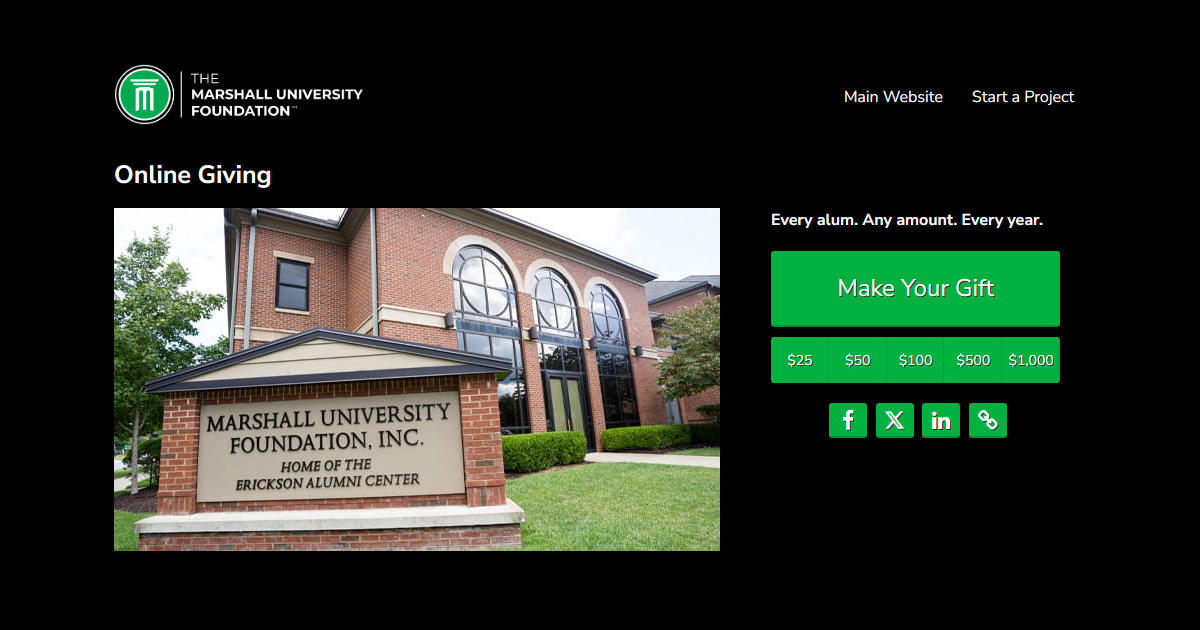
    Marshall University Foundation

    Creating a universal giving form has never been easier—you can do it in under five minutes! Need a simple form for one fund? Done. Want to showcase all 3,000 of your institution’s funds on a single page? Easy. The athletic director dreaming of a QR code in the banquet program that links to every athletic fund? Consider it handled.

    You can add unlimited custom questions to make your form as fun—or as functional—as you like. Ask for T-shirt sizes, invite donors to share their stories, or let them vote for their favorite residence hall. The options are limitless, and the setup is a breeze.

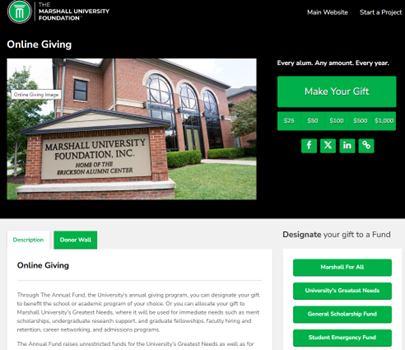
    Pictured: Our partners at Marshall University have identified nearly 20 priority funds on their Giving Form, which appear in two ways: visually appealing buttons on the project page and a searchable, scrollable list on the Giving Form.

    Maintain your identity

    UMass Amherst Foundation

    Your brand is uniquely yours and it should shine through every click, color, and contribution. When you join the ScaleFunder family, our team crafts a custom site design and background that aligns with your institution’s brand standards, colors, and tone. Every page carries that same cohesive look and feel, so donors always know they’re in your world.

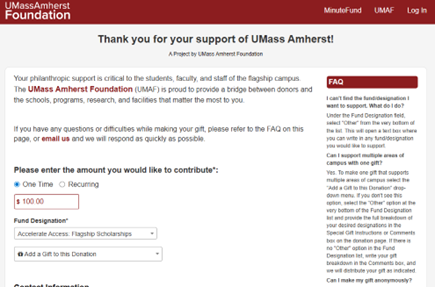
    From your logo and language to your custom domain, everything says “you,” while Google reCAPTCHA quietly works behind the scenes to reassure them that every gift is safe and secure. This consistency of branding also means it’s easy to link to your Giving Forms from external pages, just like our partners at UMass Amherst have done from their main foundation website.

    Pictured: The UMass Amherst Foundation giving page.

    Ready to learn more?

    Whether you’re exploring digital fundraising platforms or already part of the ScaleFunder family, we’d love to help you get the most out of your tools. Connect with Courtney Pourciaux, senior consultant, to learn how Giving Forms and ScaleFunder can elevate your fundraising strategy. Reach out and we can schedule a demo as well as discuss how to make your giving experience easy and consistent for your donors.

    Talk with our digital giving experts

    RNL works with institutions on digital giving and donor engagement, including crowdfunding, giving days, and omnichannel fundraising. Set up a time to talk with our fundraising experts to find your optimal strategies.

    Request Consultation

    Source link

  • The AI Teammate: Three Roles to Build Student AI Fluency – Faculty Focus

    The AI Teammate: Three Roles to Build Student AI Fluency – Faculty Focus

    Source link

  • The AI Teammate: Three Roles to Build Student AI Fluency – Faculty Focus

    The AI Teammate: Three Roles to Build Student AI Fluency – Faculty Focus

    Source link

  • The surprising pragmatism of Reform UK voters towards international education

    The surprising pragmatism of Reform UK voters towards international education

    In polls and focus groups across the country, Reform voters have been singing from the same hymn sheet. They share a deep sense of national and local decline. They view the country through a lens of crumbling high streets, strained public services, and an economy seemingly trapped in a doom loop.

    In this environment, they have developed a corrosive scepticism towards the modern university model, judging it a failed investment that saddles their children with debt for a degree that is only good for getting through graduate recruiters’ first sift of CVs. They demand contraction, utility, and accountability for a system they believe serves neither the student nor the economy.

    To delve into these views, Public First conducted focus groups with those who currently intend to vote Reform UK in university towns in England. This revealed a surprising chink of light in an otherwise very gloomy outlook on universities: focus group participants were broadly very positive about international students.

    Foreign subsidy as necessary evil

    This needs to come with a heavy caveat: when we polled Reform voters, we found that 63 per cent agree that the UK government should restrict international student numbers in order to cut net migration. Cutting net migration remains a top priority for these voters, and for many, it appears that this should be done by any means necessary.

    However, when confronted with the economics, Reform voters we have spoken to reveal a sophisticated and transactional view of international student recruitment. For them, students from overseas are not a problem to be solved, but a “great business.”

    As polling has consistently demonstrated, the typical Reform voter is highly sceptical of mass, unmanaged immigration. Yet, when asked about foreign students, the response of those who live in university towns was not hostility, but economic pragmatism.

    They see international recruitment as a clear, contained, and mutually beneficial transaction: the UK offers a world-class education (a product) and, in return, receives a higher rate of tuition fee (a profitable revenue stream). The students come to study, they contribute economically, and then – the crucial expectation – they either contribute to the UK economy or they leave.

    This isn’t merely tolerance; it’s a qualified acceptance rooted in financial necessity. In these voters’ minds, these lucrative international fees act as the foreign subsidy that keeps the entire system afloat. As one participant noted, “If universities can’t stay open because they haven’t got any foreign students, then that is a detriment to UK students.” The implication is clear: to maintain a domestic higher education offering, the international revenue stream must be protected.

    The conditions for goodwill

    This surprising goodwill, however, is fragile and rests on extremely strict conditions. Voters grant the sector a licence to recruit internationally only as long as two core boundaries are strictly maintained.

    No back doors: The arrangement must remain a transactional exchange, not a migration loophole. Support instantly evaporates when student visas are perceived as a “back door” into the country, particularly when students bring dependents or “disappear” into the country during the degree programme, or after graduation. The transaction is valid only if the purpose is learning, not permanent residency. “If you’re coming to learn, then you come to learn. You don’t bring your family, your dog, your cat and your goldfish,” argued one voter.

    No crowding out: Crucially, if voters feel that their children are being denied places in favour of higher-paying overseas customers, the economic argument collapses under the weight of perceived injustice.

    Despite the conditional acceptance of international fees, the core challenge for universities remains their perceived lack of utility to their students, and in their local communities. While Reform voters are pragmatic about international revenue streams, they are profoundly sceptical about the value of many domestic degrees that this income subsidises, and they see very little economic spillover in their towns: “…the areas outside of the city centre, I can’t see what benefit [universities] have.”

    The sector cannot win over these key voters – and thus cannot escape the threat of cuts from political parties who want their support – by simply defending the status quo. Making the case to this influential group of voters requires clearly showing how international students are paying for local resources and subsidising domestic places, while demonstrating robust checks that ensure the system is not abused.

    More widely, universities need to move beyond abstract civic rhetoric and show tangible value, taking concerted action to ensure and evidence that all degree courses benefit the student, the community and/or the country at large.

    The support for international students presents a unique opportunity. It is the one pillar of the current HE model that Reform voters’ economic logic allows them to broadly accept, even if this acceptance is currently secondary to the desire to cut net migration.

    The sector must leverage this pragmatic lifeline to pave the way to a secure future, while not telling but showing voters that their domestic offering is part of the solution to the UK’s economic doom loop.

    Source link