Blog

  • We want to make that heart beat more strongly

    We want to make that heart beat more strongly

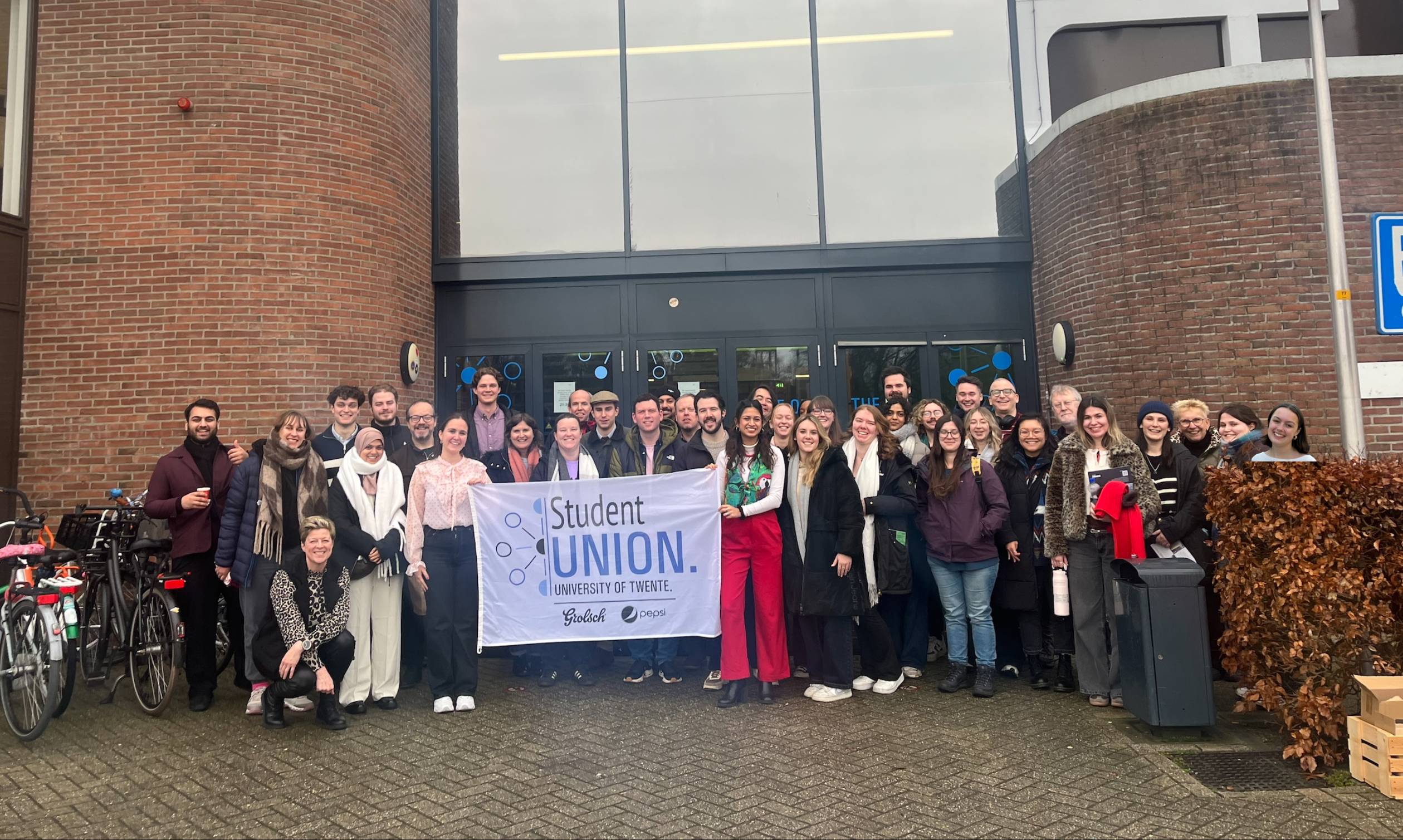
    When people look at the apparently frenetic itineraries for our SUs study tours, we’re often met with confusion about why we would even attempt to visit so many cities in so few days.

    This year we managed to fit in fifteen university cities in five days across Germany, Switzerland, France, Luxembourg, the Netherlands and both halves of Belgium – avoiding low bridges and Belgian traffic, and re-routing around the worst of Storm Goretti on a chartered bus whose toilet had frozen up.

    In total we probably spent about 24 hours on the road with our driver Rene, which on first sight looks like an agenda full of dead time which could have been better spent immersing more deeply with our numerous hosts.

    Sometimes the journeys are a good opportunity for a nap, or to sneak a look at emails, or to catch up on the gossip or just to stare out of the window at pretty houses in Spreitenbach.

    But that time on the bus can also be a great time to look at and reflect on what we don’t see, the things we’re not told, the things that don’t make it onto the slide deck or into the tours and talks that we’re treated to by our largely student hosts.

    Some of us started the week in Munich, which provided the excuse to while away at least one journey looking at the Technical University of Munich (TUM)’s Agenda 2030 strategy and teaching model.

    On most programmes students choose from a bunch of “Plug-In Modules” – short courses designed to give students from one discipline a window into another – and one of the most popular ones is called “Politics for Rocket Scientists”, an introduction to political science for people who aren’t political scientists.

    It’s a three contact hours a week, 6 ECTS (12 UK CATS) “lecture” module, an hour of which is chalk and talk by research-active political scientists, while students from later semesters in politics run “exercise” sessions.

    Assessment takes the form of a ninety-minute closed-book exam – mainly a multiple choice quiz with a couple of open-ended questions – and it’s graded on the German system of 1.0, 1.3, 1.7, 2.0, 2.3, 2.7, 3.0, 3.3, 3.7, or 4.0. And you can retake that exam unlimited times until you pass.

    Every year that it runs, a joke which we reckon is funnier in German is used to open the first module:

    Welcome to Politics for Rocket Scientists. We also run Rocket Science for Politicians, but that one is less popular.

    TUM has won awards for its teaching, where the academic model reflects its guiding principle of human-centered engineering – aimed at providing students with sufficient “integrative valency and educational capacity” to benefit the natural, engineering, life and economic sciences as well as society more generally.

    The structure – which sees bachelor’s students only studying for about half of their credits in their “major” – also sees students separately acquire credit in “soft” skills, academic induction, out-duction to the labour market and electives in related subjects.

    Students who are earning while learning on the peer teaching team are trained in the latest pedagogical techniques and take part in the university’s annual teaching innovation competition, all of which is both great for their development and for improving outcomes.

    The structure ensures that some of the research active academics can continue their work without having to sustain entire degree programmes or departments framed around their own specialism. And the university’s student-staff ratio? 40.7.

    Students need some context

    There were plenty more like that. At our first official stop – Universität St. Gallen in Switzerland – every student, regardless of their main subject, has to complete 24 ECTS of “Contextual Studies” chosen from areas like Creativity, Technologies, Cultures and Responsibility. Neither the SU President nor his huge team of elected student officers and “teamies” were paid – but had the time to undertake their roles because the learning from them counts in the structure.

    At the University of Twente in the Netherlands, the final third of the bachelor’s programme is genuinely elective – minors, free choices, preparation for different master’s routes. Students also get real control over how they learn – which projects to pursue, which workshops to attend, and when to study. Much of the scaffolding is labelled “Student-Driven Learning”, and almost always involves problem-oriented group project work that students enjoy rather than resent.

    In France in 2017 the government launched Nouveaux Cursus à l’Université – New University Curricula – with funding distributed through competitive bids to fund undergraduate curriculum transformation. The core concept is “progressive specialisation”, where students specialise gradually rather than choosing narrow tracks at eighteen, with built-in gateways between different qualification routes, and flexible routes that can combine higher technical and academic tracks.

    At KU Leuven in Belgium, the final four weeks of each semester are reserved for “lab courses” where students integrate knowledge across subjects and connect it to society. At the University of Maastricht, students don’t spend hours in lectures – they meet twice a week in tutorial groups of ten to fifteen, working through cases where assessment might be participation, presentations, essays, or exams, but where the emphasis is on whether students can use what they’ve learned.

    Bits of all of this exist in the UK, of course, and there’s plenty to be proud of when we compare some of the facilities, support systems and services that we have built in the name of “student experience” back home. But while all of these systems are under financial pressure (everyone in Europe, it seems, wants a better education population but taxpayers are reluctant to fund it), what we didn’t find was a hurtle towards “do it all” 15 ECTS (30 CATS) modules to fit a forthcoming funding system and a rapid erosion of student choice.

    More often, we found ways of delivering efficiency that were about giving students educational and social responsibility.

    Maybe their Bologna-addled minds have been warped into collaborative conformity while the UK forges ahead alone by bolstering its reputation for excellence by overloading academics. But it was hard not to feel the impacts of isolation as visit after visit casually mentioned pan-European university alliances, compulsory mobility semesters, degrees that can be built from credit from multiple universities in multiple countries and systems that sustain student leaders whose English was often better than ours.

    At various points, we were asked what they might learn from us. What not to do was the theme of our answers.

    Money honey

    Sometimes on the trips, there’s things to steal. The pot of honey we were all given on arrival in Mulhouse was created by a project aimed at causing academic and vocational students from multiple universities to interact with craft and small industry experts in the region, with a beehive in the garden of the regionally-run halls. Maybe there’s a way to get something similar going back home.

    The international student spaces we saw in Wageningen and Leuven combined space for associations, facilities for cooking and seating for studying – as a set of (comparatively) skeleton set of staff to facilitate student-run study sessions, cultural nights and interaction both between international students and with those from the home countries. We’d face questions about risk assessments and students’ willingness to get involved – but there’s a pilot in there somewhere.

    The posters up in Strasbourg asking students if they thought all the hours they were having to work were “normal”, the student (and staff) arts centre in the middle of an ostensibly STEM-oriented university, the student-run city-centre study spaces projects we saw in different forms, the lighting and the furniture and the St Gallen symposium – they’re all worthy of a try, if we can find the time.

    Sometimes those long journeys between stops allow us to wallow not in possibility but its opposite – it’s the culture of the country, it’s a hundred years of history, it’s the funding system or the governance of student services away from the academic endeavour that produces the Truman show of magic in the powerpoints and presentations that must mask worse mental health problems and higher attrition than we enjoy in the UK.

    But sometimes the projects – like the one at the Eidgenössische Technische Hochschule (the Swiss Federal Institute of Technology in Zurich – were the antidote to such moments of pessimism.

    Easier and more enjoyable

    In the autumn of 2021, Sarah Hofer – a researcher who had previously documented how teaching methods rather than student ability explained vast gender gaps in physics performance – returned to ETH as a professor.

    She quickly got to know the student board at VMP – the maths and physics student association – which has been making studying easier and more enjoyable for its members for 80 years.

    Somewhere between an academic society and a set of course reps, it’s a bit of associative scaffolding that runs its own little welcome week, offers group social mentoring on arrival, provides old exams and organizes assessment preparation courses, and puts on poker and chess tournaments, fondue nights, parties and barbecues. And the VMP offers its members one free coffee a day at its lounge on campus.

    It also stages its own careers fair, holds formal representation on departmental governance structures including the Departement conference (the highest departmental body), teaching committees, and grading conferences where exam standards are set.

    It has working groups on sustainability and conduct, it has a project that focuses on equal opportunities through coffee lectures with professors, organises company excursions and social gatherings for computational science students, and supports international and master’s students with practical issues like housing and supervision.

    Events include weekly talks on theoretical physics, an undergraduate colloquium with student presentations and apéro (think wine, beer, soft drinks, nibbles, and light finger food), as well as social events like ski weekends, fondue nights, and poker tournaments. Its student magazine VAMP publishes twice a semester in print and digital formats. And so on.

    Unlike in the UK, where much of what it offers would be delivered for students by professionals in separate centrally-run departments inside student services or the SU, the assumption is that peer delivery backed up by the centre and associatively scaffolded at faculty level is good for the volunteers, good for belonging, good for innovation and good for students. Broadway musicals fail – school plays sell out.

    And for Sarah Hofer, it was the perfect partner for operationalising some of her research.

    No dumb questions

    The idea was simple – create “exercise class” groups aimed at students who self-assessed as having less prior knowledge and/or imposter syndrome, where students facilitating would spend more time on fundamentals and where a “there are no dumb questions” culture was explicit rather than aspirational.

    The pilot worked. Participants who might have been expected to underperform passed at higher rates than for the cohort overall, all via an intervention that was part-belonging, part-pedagogical and part-confidence building, changing the composition of the room so that nobody has to perform competence they don’t feel.

    Workshops train TAs to think about what stops people asking questions – the group composition means there’s less stopping them. The research had said teaching methods were the barrier, not student ability. The recognition that heterogeneous prior knowledge makes some students fall silent, and that silence compounds, had found an outlet in a student society.

    When Hofer left ETH for LMU Munich less than a year later, the initiative didn’t leave with her. VSETH kept running it. The SU now provides significant implementation infrastructure – recruiting student TAs, coordinating with departments, embedding it in their broader educational development work.

    A working group – AG Fokusgruppen – sits under VSETH and works through the faculty student associations. Klara Sasse, who became the key student lead, was simultaneously active in VMP (the maths and physics faculty association, established over 80 years ago). Her dual positioning mattered – she could advocate at university level while having credibility and networks within the specific departments where focus groups needed to be implemented.

    Departments have adopted it enthusiastically – Physics merged it with their existing Exercise Class Market infrastructure – but ownership remains with the SU. Klara has since become VSETH Vice President, VMP President, and Head of Communications at VSS (the national Swiss student union), and won second place in ETH’s individual Diversity Award 2024. The focus groups themselves won third place in the organisation category the same year.

    I could KOKO

    We heard so many stories like it during the week. They were rarely about responding to regulation, or delivering on KPIs, or lobbying the university to “provide” more for students. They were more often about students having the associative infrastructure – not so small as a course rep, not so large as a university-wide SU or student services department – to do things for each other.

    Sometimes, ECTS credits were on offer. Sometimes students were paid for their work. One system saw students financially supported to pause while serving others for a semester. But almost without fail, when we interrogated why those in front of us had got involved, the money or the time or the academic recognition were always second-order hygiene. The real answer was always that they wanted to be the person that had first helped them.

    At student social association KOKO in Maastricht, student chair Japke Zoon directs the board, oversees policy implementation, and maintains contact with Maastricht University, Zuyd University of Applied Sciences, the municipality, and other key partners. Sophie van Oosterhout oversees the bar committee, the club building, and safety during activities and parties.

    Both Japke and Sophie were viscerally impressive and eminently employable – but it wasn’t really the things in their job descriptions that mattered the most. In conversation, it was the student who needed support, the first year that was thinking about dropping out, the international student who felt lonely, and the neurodiverse students who found a way to socialise with those who weren’t. Sophie was responsible for changing a barrel, but she was really responsible for other students’ success.

    Cecile Kwekeu took the mic next – Secretary and Academic Co-Comissionier of SCOPE, the official study association of the university’s School of Business and Economics. She’s 20, originally from a small city in Germany, and got involved when she went to a Maastricht Business Days event:

    As Academic Commissioner, my mission is simple: make sure our events actually help you grow. Whether it’s soft skills like communication and networking or hard skills like analytical thinking, I want to create opportunities that matter – both now and down the road. This year, I’m heading up some exciting projects including the Symposium, Consulting Case Challenge, Business Case Challenges, Career Development Days, and our Brussels Trip.

    She also talks of building better systems, streamlining processes, and making sure her team can get the most out of student life. She and over 350 students like her across the university are helped by a bit of scaffolding that allows students to pause their studies to undertake an association board year or semester – and in turn, they support thousands of students to support others through projects, groups, committees and events.

    The cold never bothered me anyway

    None of it should be a surprise. Plenty of academic theory tells us that whole chunks of our lives have become increasingly hyper-organised, professionalised, and compliance-driven, adopting formal structures, metrics, and professionally-led processes that mirror “good organisation” norms but unintentionally erode amateur-led energy.

    Money, measurement, risk management, staffing growth, and symbolic compliance often displace informal, trust-based activity. There’s evidence from wider civic life that shows that declining volunteering, loss of social infrastructure and low institutional trust is part of a broader hollowing-out of associational life, and has deep impacts on mental health, trust in governments and attitudes to others.

    Increasingly, what we do in adult life is what students do – taking part in technically excellent but tightly controlled, professionally-run, highly transactional service provision – and in doing so there’s a crowding out of participation, a reduction in social solidarity and a widening of the intention–behaviour gap for those who might otherwise help others.

    Letting go is hard. The pressure on UK students’ time is real. The regulation demands safety, the funding follows the metrics, and everyone remembers that time when that thing went wrong before the grown-ups took control. But this is less about letting go, and more about creating the conditions for student success.

    Live and kick-in

    When Frans van Vught got elected as Rector Magnificus of the University of Twente back in 1997, he inherited a technical university with declining student numbers, fragmented departments, a huge hole in the budget and a culture that had attempted to fix things by doing more centrally:

    Campus life was bureaucratically controlled by a campus director. Not much was allowed, there were closing times, and students had to apply for permits for all kinds of things. I found that very unappealing. I felt that as a campus, or rather as a university community, we should be able to do better than that. Let the students organise things themselves.

    Many encouraged Van Vught to retain the systems and structures that had been built up, only to operate them more efficiently. Instead, he set about shifting the culture both academically and socially – designing structures and scaffolds that would sustain a collaborative community with benefits both for individuals too.

    And after his own study visit with some of his student associations to Queens in Belfast, he returned and set up the SU, giving it (against available advice) a raft of responsibilities previously assumed to be the university’s – all on the condition (agreed in a covenant) that they found student groups to run them.

    “Universities have to take care not to become a bundle of non-communicating hyperspecialisms”, he said on the day he retired – bearing the scars on his back from a radical restructure:

    [Students] are a very important part of the academic community and I think it’s important that they take their own responsibility… we have increased cohesion in student activism and increased the community feeling for the university as a whole.

    Today, the SU hosts a student-led outreach and talent development programme for secondary school pupils, a £0.5m student run “kick in” welcome programme designed to build belonging, study space facilities across the city and hundreds of other student committees that operate everything from student support to PC repairs to the world’s biggest case competition.

    The wider academic infrastructure helps. Every department gives space to an an academic student association on the basis that students need a “home” to work together in. On their courses, students work in multiple teams over extended periods, encouraging early peer bonding, a sense of belonging, and shared responsibility, reducing anonymity and social isolation.

    There’s an emphasis on collaboration, role negotiation, and joint problem-solving that develops interpersonal skills like communication, empathy, and conflict management, while the coaching role of staff an integrated authentic assessment structure strengthens confidence, creativity, self-efficacy, and emotional resilience by providing an environment where students learn from mistakes and high-stakes pressure is reduced.

    On the tours, we often pick up the differences in dual systems between elite universities and their old ideals of education for education’s sake, and newer players in the applied sciences who focus on labour-market prep. On paper, Twente ought to have been the most individualistic, transactional, skills-for-the-CV provider on the trip. But it wasn’t.

    The Netherlands has a much higher percentage of students working while studying than the UK. Belgian and French students are just as likely to be struggling with the costs of living. Students in Luxembourg find it difficult to afford their placements, and Bavarian students are attempting to rent the most expensive student bedrooms in Germany. Even Swiss students struggle to maintain the sort of student experience that their parents said was possible.

    But while HE and student funding was never far from the top of the lists of problems on the slides, it was also repeatedly obvious that the spaces and structures deliberately designed to create collaboration, engender responsibility and operate autonomously were helping to ensure that students were both transformed by their education, and were helping to transform both their university and their municipality as a result.

    Society concerns social relationships and civic participation. Social networks provide support and contribute to quality of life. It is also important that everyone can participate in society, and trust other people, the government and other institutions.

    Statistics Netherlands (CBS) reports that in 2024, 49.5 per cent of the population aged 15+ did voluntary work for an organisation or association at least once in the previous year – and it’s much higher for graduates. In the end, both in the university and the country, isn’t HE partly about the community you’re trying to create?


    Source link

  • Breaking barriers: what the data tells us about care experienced and estranged applicants

    Breaking barriers: what the data tells us about care experienced and estranged applicants

    Over the weekend, HEPI published blogs considering whether we are fixing or unmaking universities, and asking why there haven’t been more institution mergers.

    This blog was kindly authored by Fiona Ellison, Co-Director, Unite Foundation.

    It is the fourth blog in HEPI’s series with The Unite Foundation on how to best support care experienced and estranged students. You can find the first blog here, the second here, and the third here.

    Higher education is often described as a transformative experience, but for some students the journey begins with significant barriers. Care experienced and estranged applicants – those who have spent time in care or are studying without family support – face unique challenges that impact their access, retention and success. At the Unite Foundation, we believe that the first step toward creating a more inclusive sector is to understand the data that underpins these challenges. We are grateful to do this in partnership with our long-term donor – Unite Students.

    In 2022, Unite Students first undertook their annual applicant index, which sheds light on the experiences of students starting university for the first time. This year, we’ve been able to compare the experiences of ‘traditional’ students with those who identify as either care experienced or estranged. The findings reveal stark differences in financial pressures, mental health, social connection and academic engagement.

    Who are we talking about?

    Across two years of survey data, 370 respondents identified as care experienced or estranged, compared to 2,981 who did not. These students are not a homogenous group, but patterns emerge: they also reflect a diverse demographic profile. For example, 17.8% of care experienced and estranged applicants identified as transgender, compared to just 2.3% of other applicants. Similarly, 3.8% identified as non-binary (vs 1.6%). These figures highlight the intersectionality of working with this group of students – we know that if you can get it right for care experienced and estranged students you can get it right for all students.

    The impact of financial pressure on mental health

    Financial insecurity is a recurring theme. Over a quarter (27.3%) of care experienced and estranged applicants reported that financial issues affect their mental health, compared to 19.6% of their peers. This is not surprising. Without family support, these students often navigate university life without the safety net others take for granted. We know from HEPI, TechnologyOne and Loughborough University’s Minimum Income Standard for Students that those studying without financial support – e.g. care experienced & estranged students – even with the full maintenance loan, would still need to work over 20 hours at minimum wage to achieve the minimum income standard needed to survive at university.  

    The implications are clear. Financial stress compounds mental health challenges, which in turn affect academic performance and retention. This was clear from the analysis we did of the Student Academic Experience Survey, which found that 43% of care experienced students and 44% of estranged students have considered withdrawing from university, compared to 28% of their peers

    Whilst the survey doesn’t give us insight into the reasons why, it does provide clues. For example, care-experienced students and estranged students work significantly more hours in paid employment, with care experienced students working, on average, 11.3 hours/week, and estranged students working 11.1 hours/week, compared to 8.8 hours/week for other students. 

    Social isolation and belonging

    University is often marketed as a time of social connection, but for many care experienced and estranged students, isolation is the norm. Only 26.8% said they have someone to turn to in a crisis, compared to 42.3% of other applicants. More than one in five (21.8%) expressed little interest in the social side of university life, almost double the proportion of their peers (11.2%).

    Pleasingly, expectations of belonging are similar across groups. 53.2% of care experienced and estranged applicants expected to feel a sense of belonging at university, compared to 54.8% of others. We know through our work supporting the All of Us Community – a space for all care experienced and estranged students to come together and connect with their peers – that creating opportunities for connection to help build that sense of belonging is crucial which is why we offer our ‘Funding for Fun’ small grants pot to facilitate connection between students online and in person across institutions.

    Learning challenges and attendance

    Academic engagement is another area of concern. Care experienced and estranged applicants are twice as likely to have prolonged absences due to mental health:

    • 22.9% missed 5–20 days in the past two years (vs 11.0% of non-care experienced students)
    • 21.9% missed more than 20 days (vs 10.1% of non-care experienced students).

    They are also more likely to struggle to keep up with their course (27.3% vs 18.8%). We know that this group of students are more likely to be working additional hours to fund their studies and this takes a toll on their ability to commit time to studies.

    That’s why, for students who received the Unite Foundation scholarship, we see their progression rates from year 1-2 at the same rate as non-care experienced peers and they graduate at a rate much closer to their non-care experienced peers. They’re not having to work as many hours as their peers, as they have a safe space to live with their rent covered for 365 days a year, for up to 3 years.

    This requirement to work to fund their studies shows up in the data – a striking 38.7% of care experienced and estranged applicants report significant work experience, compared to 27% of their peers.

    What does this all mean?

    The data tells a clear story: care experienced and estranged students face systemic barriers that cannot be solved by goodwill alone. Financial support, mental health provision and inclusive community-building must be embedded in institutional strategies.

    For policymakers, this means recognising these students as a priority group in widening participation agendas – not just paying lip service, but embedding and regulating for action. For universities, it means moving beyond access to focus on retention and success – using evidence based solutions, such as the Unite Foundation scholarship to create the conditions to enable care experienced and estranged students to thrive.

    If you want to explore how action to address accommodation issues can better support you care experienced and estranged students the Unite Foundation Blueprint framework can support your institution in building a safe and stable home for students, improving retention and attainment outcomes.  

    Source link

  • OPINION: Colleges must start treating immigration-based targeting as a serious threat to student safety and belonging  

    OPINION: Colleges must start treating immigration-based targeting as a serious threat to student safety and belonging  

    by Madison Forde, The Hechinger Report
    January 12, 2026

    Last month, a Boston University junior proudly posted online that he had spent months calling Immigration and Customs Enforcement to report Latino workers at a neighborhood car wash.

    Nine people were detained, including siblings and a 67-year-old man who has lived in the U.S. for decades. The student celebrated the arrests and told ICE to “pump up the numbers.”

    As the daughter of Caribbean immigrants and a researcher who studies immigrant-origin youth, I was shaken but not surprised. This incident, which did have some backlash, revealed a growing problem on college campuses: Many young people are learning to police one another rather than learn alongside one another.

    That means the new border patrol could be your classmate. Our schools are not prepared for this.

    That is why colleges must start treating immigration-based targeting as a serious threat to student safety and belonging and take immediate steps to prevent it — as they do with racism, antisemitism and homophobia.

    Related: Interested in innovations in higher education? Subscribe to our free biweekly higher education newsletter.

    The incident at Boston University is bigger than one student with extreme views. We are living in a moment shaped by online outrage, anonymous tip lines and a culture that encourages reporting anyone who seems “suspicious.”

    In this environment, some young people have started to believe that calling ICE is a form of civic duty.

    That thinking doesn’t stay online. It walks right into classrooms, dorms and group projects. When it does, the impact is not abstract. It is deeply personal for the immigrant-origin youth sitting in those same rooms.

    Many of these students grew up with fear woven into their daily lives. Their neighbors disappeared overnight, they heard stories of parents being detained at work and they began translating legal mail before they were old enough to drive. They know exactly what an ICE call can set into motion. They carry that fear with them to school.

    These are not hypothetical harms. They show up in everyday decisions: where to sit, what to say, whom to trust. I’ve met students who avoid speaking Spanish on campus, refuse to share their address during class activities and sit near the exits because they’re not sure who views their family as “a threat.” It is not possible to learn well in an environment where you do not feel safe.

    There is a strong body of developmental research highlighting belonging and social inclusion as central to healthy development. In her work on migration and acculturation, Carola Suárez-Orozco shows that legal-status-based distinctions among youth intensify exclusion and undermine both social integration and developmental well-being.

    When belonging erodes, colleges begin to function like small border zones, where everyone is quietly assessing who might turn them in. It is nearly impossible for any campus community to thrive under that kind of pressure.

    Quite frankly, nor can America’s democracy.

    If we raise a generation of students who feel compelled to police the nation’s borders from their dorms, the immigrant-origin youth sitting beside them in classrooms will carry the psychological burden of those borders every single day. Yet colleges are almost entirely unprepared for this reality.

    Most universities have clear policies for racial slurs, antisemitic threats, homophobic harassment and other identity-based harms. But very few have policies that address immigration-based targeting, even though the consequences can be just as severe and, in some cases, life-altering.

    Boston University’s president acknowledged the distress caused by that student’s actions. Yet, the university did not classify the behavior as discriminatory, despite the fact that his calls targeted a specific ethnic and immigration-status group. That silence sends a clear message: Harm against immigrant communities is unimportant, incidental or simply “political.” But this harm is neither political nor the price of free expression or civic engagement; it is targeted intimidation, with real and measurable consequences for students’ safety, mental health and academic engagement.

    In my view, colleges need to take three straightforward steps:

    1. Define immigration-based harassment as misconduct. Calling ICE on classmates, doxxing immigrant peers or circulating immigration-related rumors should be classified under the same conduct codes that protect students from other forms of targeted harm. Schools know how to do this; they simply have not applied those same protections to immigrant communities.

    2. Train faculty and staff on how to respond. Professors should have a clear understanding of what to do when immigration rhetoric is weaponized in the classroom, or when students express fear about being reported. Although many professors want to help, they may lack basic guidance.

    3. Teach immigration literacy as part of civic education. Most students do not understand what ICE detention entails, how long legal cases can drag on or what it means to live with daily fear like their immigrant peers. Teaching these realities isn’t “political indoctrination,” it is preparation for a life in a multicultural democracy.

    These three steps are not radical. They are merely the same kinds of protections colleges already provide to students targeted for other aspects of their identity.

    Related: STUDENT VOICES: ‘Dreamers’ like us need our own resource centers on college campuses

    The Boston University case is a warning, not an isolated moment. If campuses fail to respond, more young people will internalize the idea that policing their peers is simply part of student life. Immigrant-origin youth, who have done nothing wrong, will carry the emotional burden alone.

    As students, educators and researchers, we have to decide what kind of learning communities we want to build and sustain. Schools can be places where students understand one another, or they can become places of intense surveillance. That choice will shape not just campus climates, but also the society current students will eventually lead.

    Madison Forde is a doctoral student in the Clinical/Counseling Psychology program at New York University.

    Contact the opinion editor at [email protected].

    This story about immigration-based targeting at colleges was produced by The Hechinger Report, a nonprofit, independent news organization focused on inequality and innovation in education. Sign up for Hechinger’s weekly newsletter.

    This <a target=”_blank” href=”https://hechingerreport.org/opinion-colleges-must-start-treating-immigration-based-targeting-as-a-serious-threat-to-student-safety-and-belonging/”>article</a> first appeared on <a target=”_blank” href=”https://hechingerreport.org”>The Hechinger Report</a> and is republished here under a <a target=”_blank” href=”https://creativecommons.org/licenses/by-nc-nd/4.0/”>Creative Commons Attribution-NonCommercial-NoDerivatives 4.0 International License</a>.<img src=”https://i0.wp.com/hechingerreport.org/wp-content/uploads/2018/06/cropped-favicon.jpg?fit=150%2C150&amp;ssl=1″ style=”width:1em;height:1em;margin-left:10px;”>

    <img id=”republication-tracker-tool-source” src=”https://hechingerreport.org/?republication-pixel=true&post=114272&amp;ga4=G-03KPHXDF3H” style=”width:1px;height:1px;”><script> PARSELY = { autotrack: false, onload: function() { PARSELY.beacon.trackPageView({ url: “https://hechingerreport.org/opinion-colleges-must-start-treating-immigration-based-targeting-as-a-serious-threat-to-student-safety-and-belonging/”, urlref: window.location.href }); } } </script> <script id=”parsely-cfg” src=”//cdn.parsely.com/keys/hechingerreport.org/p.js”></script>

    Source link

  • Designing AI-Resistant Assignments in Educational Leadership Courses – Faculty Focus

    Designing AI-Resistant Assignments in Educational Leadership Courses – Faculty Focus

    Source link

  • Designing AI-Resistant Assignments in Educational Leadership Courses – Faculty Focus

    Designing AI-Resistant Assignments in Educational Leadership Courses – Faculty Focus

    Source link

  • So you’ve been accused of harbouring “Mickey Mouse” courses at your institution…now what?

    So you’ve been accused of harbouring “Mickey Mouse” courses at your institution…now what?

    Margaret Hodge’s 2003 speech to the Institute of Public Policy Research on “achieving excellence and equality in post-16 education” tells us that even under New Labour policy announcements on higher education were “long-awaited.”

    The speech illustrates how then, as now, the government was grappling with questions of growing and massifying participation while retaining the sector’s global competitiveness; promoting specialisation and collaboration; boosting quality and civic engagement.

    Hodge had taken to the stage to explain the government’s plans for driving up HE participation to at least 50 per cent of young people and signal the themes of its forthcoming higher education strategy – but warned that doing so via “stacking up numbers on Mickey Mouse courses” was “not acceptable.”

    Hodge’s usage shows that she – or her speechwriter – assumed that the meaning of the term “Mickey Mouse course” was widely understood. But as DK has explored elsewhere on the site, Mickey Mouse’s meanings when applied to higher education have shifted and evolved according to cultural context.

    What has remained consistent, however, is the assumption that there is a chunk of HE provision that all right-thinking people can see obviously shouldn’t “count” as HE – because it’s unserious, or too popular, or on a topic that’s not traditionally been seen as academic or, in the recent analysis from the Taxpayer’s Alliance, ideologically suspect.

    Let’s imagine you’re a university press officer looking at a message on your phone or a note in your email inbox requesting that you explain succinctly by 3pm today why it’s entirely sane and reasonable to offer courses in e-gaming, fashion, filmmaking, tourism, mental health, gender identity, outdoor learning, climate change, sports or any one of a long tail of stuff the proverbial man on the Clapham omnibus wouldn’t see the point of. What’s your strategy?

    Make it go away

    Back in 2003, the BBC reports that Margaret Hodge swiftly felt the sharp end of university leaders’ tongues, who apparently said her remarks were “offensive” and “ill-informed.” It’s hard to imagine a government minister getting such short shrift from the sector today – while some of the issues might look similar, the political landscape has changed enormously.

    Even so, Option One, the dismissive approach, is seductive. There are several flavours of dismissive available: you could point out that higher education institutions hold their own degree awarding powers, are responsible for their own quality and academic standards, and curriculum, and that ergo, any course provided by a legitimate HE provider is de facto itself legitimate. Or you could question the motives of the questioner and suggest that the framing is a political act designed to discredit universities and higher education by those who wish the sector ill. The moral high ground feels pretty good, and has the advantage of refusing to concede the principle of the question, but it doesn’t necessarily contribute to public understanding of contemporary higher education.

    A whole bunch of institutions approached for comment simply did not respond – possibly because they were asked to do so during the Christmas break but it may also have been because they refused to dignify the question with a response, an approach that might be characterised as Option One (b).

    De-escalate

    The institutions who chose to respond to the Telegraph when confronted with the evidence amassed by the Taxpayers’ Alliance seem to have in the main gone for Option Two: explain and clarify – and try to wedge in a plug for the institution.

    Thus the University of Cumbria’s spokesperson explains that its MA in outdoor experiential learning is “designed for those passionate about transforming education, inspiring sustainability, and reshaping how we engage with experience in learning” – and notes that the university is in the top ten for graduate destinations. The University of Nottingham’s spokesperson points out that its workplace health and wellbeing course is postgraduate level, and therefore not taxpayer funded – and says the course encourages “a rigorous scientific approach that fulfils and exceeds legal requirements to support organisational performance and effectiveness and enhance worker productivity.”

    There are absolutely merits to this approach – essentially it smothers the reputational fire with approved corporate narratives. When the Telegraph comes to call during the Christmas break you probably don’t lob your scanty communications resources at anything other than de-escalation. This, arguably, is not the moment to start a media scrap and find yourself inadvertently the “face” of the Mickey Mouse debate. Experience shows that that sort of thing can haunt your institution for ages and goodness knows everyone’s got enough to worry about without that.

    Engage in the debate

    But we should give at least a decent bit of consideration to Option 3: full-throated defence offered in language that people recognise as meaningful. That means more or less grudgingly accepting the premise that it’s hard for everyone to see why some lucky, lucky students get to study something as fun and creative and glamorous as fashion or “the outdoors” or identity or filmmaking. It involves painting a succinct picture of what these subjects achieve for students, and industries, not in big picture stats but in human terms, in stories.

    I have two children, one in a state primary which, like many, have invested in a forest school. When my son was in reception he got to learn outdoors once a week; since then it’s been once a term at most. I can’t believe I’m the only parent of an active kid that is troubled by how little time the system affords kids to learn in and about nature.

    Or, not to make this all about my kids, but being a parent computer games are a pretty big feature of my life. I can see how gaming can offer opportunities for my kids to problem solve and develop tactical and situational awareness, but I want to be sure they are safe when they do that – thanks, e-games courses.

    Or, I’m a middle aged woman who sometimes struggles to find clothes that feel right for my professional and personal identity. Or I’m someone who wants to understand why the gender identity “debate” has become so toxic and what my orientation to it should be. Or I’m worried that my efforts to put my rubbish in the right bins isn’t going to deliver on that net zero target and is that even a useful target anyway?

    OK, my preoccupations are very obviously filtered through the lens of middle-class London liberal. I’m not suggesting I’m a typical Telegraph reader – but I’m using my own sense of what the existence of these courses might mean for me to illustrate the point that lots of them touch people’s everyday concerns in ways that could be surfaced more powerfully.

    The “Mickey Mouse” accusation runs deeper than notions of social irrelevance, however – inherent in the proposition that something is “Mickey Mouse” is calling into question whether these are subjects and courses that deserve to be part of the thing we call higher education. And that’s a much harder challenge to defend because doing so may feel like to do so requires a referral back to expertise, or knowledge that is inaccessible to the common reader and therefore will struggle to “cut through” in any media response.

    Outside the realm of quality and standards regulation the question of why something is a legitimate source of higher education study speaks to the range of conceptions of higher education value. Is it worthwhile because there is labour market demand for it, because it is sufficiently complex to constitute a structured body of knowledge that merits deep intellectual engagement, because the resourcing required to study it is only accessible in higher education contexts, because of its wider social relevance or some thrilling combination of all these? And how on earth do you capture all that in a media quote?

    I’ve been puzzling over this all week, and have come to the conclusion that there can’t be a silver bullet on how to defend the HE-ness of any given course, especially when the framing of the scepticism is so multi-faceted. One person’s useful market labour skills is another person’s intellectual lack of rigour. There’s no easy “win” available for this argument – but there might be a position to take that feels authentic and worthwhile that is rooted in the course’s own conception of itself and its meaning and value set within the wider institutional framework of mission and purpose.

    Latent to salient

    It’s not, I think, that institutions and their staff have no sense of why their courses are meaningful as higher education, but that this knowledge is so deeply embedded in the structures and cultures of the institution as to be almost entirely latent and unarticulated. Yet to be able to capture any of this pithily and in the teeth of a sceptical line of questioning that knowledge needs to be explicit and intentionally surfaced.

    Any institution will have a stock of anecdotes, insight and ideas about why their courses matter, in human terms. This knowledge isn’t always held in comms teams, who are not always linked closely with the nuts and bolts of the academic endeavour . It’s not an easy ask, but I’d argue that it’s worth comms teams spending some real time in some of the university’s less “mainstream” course offerings, putting forward the sorts of the challenges around value that a hostile media outlet or think tank might present and understanding the nuances of the answers before working them into something media-friendly. Don’t just talk to the programme leaders, ask to audit the classes. Direct experience trumps course marketing brochure every time.

    Because when it comes to that unexpected phone call or email asking for the justification for these woke, un-rigorous, pointless degrees, and deciding how best to respond, it’s great to at least have the option to explain why these courses are not merely legitimate higher education provision, they are essential for the furtherance of human flourishing.

    Source link

  • Identifying “mickey mouse” courses | Wonkhe

    Identifying “mickey mouse” courses | Wonkhe

    St Valentine’s Day, 1966. Salem, Oregon.

    State legislator Morris Crothers (Salem-R), a qualified doctor, is unhappy with a Bachelor’s degree in Medical Technology offered by the Oregon Technical Institute (OTI, formerly Oregon Polytechnic).

    The Capital Journal reported his words:

    a mickey mouse degree that would not allow those earning it to practice in most Oregon laboratories.

    His issue isn’t with the content of the degree, but with his perception that it does not qualify a graduate to perform certain licensed tests (including the pre-marriage test for syphilis) in the state of Oregon. I say perception because it turned out he was wrong and the course was accredited – 131 graduates were already employed by the state. His real issue was that OTI wasn’t a proper four-year college, and had low entry requirements.

    OTI chancellor RE Lieuallen responded (as recorded in The Oregonian): “Here we get into the question of the liberal arts background … some people would say that a job-oriented programme is better”.

    Crothers withdrew his accusation, claiming “the news media quoted me a little out of context”.

    This is the earliest published newspaper use of the pejorative term “mickey mouse degree”. And it betrayed a lack of understanding, and a certain level of snobbery, rather than academic failings.

    From Morris to Maurice

    In the academic literature a letter to journal American Speech from Michigan State University’s Maurice Crane slightly predates Salem’s tawdry tale: in 1958 (volume 33, number 3) his letter (“Vox Bop”) offers a partial lexicon of historic midwestern jazz slang, in which he observes:

    Incidentally, a mickey or Mickey Mouse band is not merely a ‘pop tune’ band … but the kind of pop band that sounds as if it is playing background for an animated cartoon. […] This term, which has been around almost as long as Mickey Mouse himself, has also come into common parlance in another sense at Michigan State, where a ‘Mickey Mouse course’ means a snap course, or what Princeton undergraduates in my day called a gut course

    It’s unhelpful to have slang defined by reference to earlier slang, but Collins dictionary tells us a snap course was “an academic course that can be passed with a minimum of effort”.

    For things dismissed as “hobby courses” – usually arts, crafts, and leisure pursuits – there is a suspicion that such provision lacks academic rigour. The economic value argument is less pronounced here – the sheer size of the Disney industry is just one example of just how much money and time human beings devote to hobbies and interests.

    The jazzman’s derivation is interesting in that jazz is itself based on “pop tunes” – the distinction Crane draws is around the manner of playing rather than the repertoire itself. Whether you play them with a “hip” jazz inflection or a “square” pop sensibility these are difficult tunes that are challenging to play and perform well.

    Morris dancing

    The first UK press sighting of the term was in 1972 – the Nottingham Guardian Journal published a letter from an irate Loughborough resident concerning governance problems at the Institute of Race Relations (a “so-earnest group of sociologists, permissives, and mickey mouse degree holders all speaking at the same time.”)

    Here the mouse is used to infer suspicions about the political project underpinning a degree course – in the same way that the likes of the Taxpayers Alliance is able to classify courses on topics as complex and crucial as climate science and mental health as being “mickey mouse.”

    Although Margaret Hodge famously used the term in a speech to the Institute for Public Policy Research on 13 January 2003 she did not coin the phrase. Her perhaps ill-chosen words masked the actual intent of her speech – she was attempting to encourage the growth of two-year foundation degree provision in subjects that met the needs of local industry. This is a diametrically opposite position to the one taken by Morris Crothers – which serves to illustrate why the idea has become so useful. A “mickey mouse degree” is simply a term for higher education provision that the speaker doesn’t like.

    Many of the early media examples on this side of the Atlantic are actually playful subversions of the trope (University of Exeter drama lecturer Robin Allan received “Britain’s first PhD on Walt Disney” in 1994 – the Torquay Herald Express tells us that Mickey himself turned up on graduation day!) suggesting that the term had currency long before the term was introduced to the parliamentary record. That wasn’t Margaret Hodge either – Liberal Democrat MP Simon Hughes used the phrase to defend the University of Westminster from that attack in the media, in a debate on the private City of Westminster Bill in June 1995.

    You’re so fine you blow my mind

    So to describe a course as “mickey mouse” is to make a judgement that it is either academically frivolous, politically suspect, or economically worthless: and – importantly – popular. A drawing of an anthropomorphic rodent is worthless, while Mickey Mouse himself is worth billions of dollars to the Disney corporation: to use the term is to ignore a widely perceived value in favour of your own judgement.

    For this reason, a list of “mickey mouse courses” – such as the one published by the Telegraph on 3 January is the purest expression of the long running “low quality courses” debate. It floats free of metrics and data simply to reinforce prejudices.

    The 787 courses identified by a researcher (Callum McGoldrick) at the Taxpayers’ Alliance were selected based on his own judgement and assigned to one of five categories:

    • Fashion (including textiles and jewellery)
    • Games (by which I mean computer games industry related courses)
    • Media (film, photography, and – with apologies to Maurice Crane – both jazz and popular music)
    • Woke (inevitably – mostly things to do with ethnicity, gender, mental wellbeing, and sustainability)
    • Misc (which includes specifically leisure-linked vocational courses, and more general arts and crafts provision)

    There’s no distinction drawn between undergraduate, postgraduate, and non-credit-bearing provision, and (as the article illustrates) not all of the courses described are currently recruiting or funded via student loans. Courses were drawn from a series of freedom of information requests – so the list, as well as being arbitrary, is not exhaustive. It covers just 51 providers.

    It feels like a horribly labour intensive way of getting an article into the Telegraph, and as a service to contrarian think-tanks everywhere I’ve built a little tool to optimise the process. Just type a word that makes you angry into the box on the left and you get both a count and a complete list of currently recruiting undergraduate courses with that word in their title to give you that special tingly feeling.

    [Full screen]

    The bigger question

    In a 2003 article for the Guardian, Emma Brockes examined the “mickey mouse” course industry in the light of Margaret Hodge’s comments noting that “every generation has its Mickey Mouse degrees – arts subjects were mocked in the 60s and 70s, sociology in the 80s and gender studies in the 1990s.” She noted:

    “There are degrees made ludicrous by virtue of their specificity (a BA (Hons) in air-conditioning). There are degrees ridiculed for their non-specificity (citizenship studies, which, to its detractors, is so broad that it might as well be called “shit that happens in the world” studies). There are the apparent oxymorons – turfgrass science, amenity horticulture, surf and beach management and the BSc from Luton University in decision-making, which begs the cheap but irresistible observation, how did those on the course manage to make the decision to take it in the first place?

    She hangs her piece on an interview with the news editor of the Coalville and Ashby Times – one Paul Marston, a recent media studies graduate from De Montfort University. Though he does mount a defence (which Brockes rather snootily describes as half-hearted) of the relevance and interest of his degree, he laments that:

    I’m finding it difficult to move on in my career now, and I do put that down partly to my degree. It was very general, very broad, good for keeping my options open, but it doesn’t seem to have prepared me for anything much else.

    The early 00s were perhaps not the most auspicious point to begin a career in local journalism, but linkedin does confirm that Marston has had a successful career in media and communications – currently leading internal communications for defence company MBDA. It’s not clear his media studies degree directly prepared him for that role, but it feels reasonable to suggest it may have had an impact, in the same way that niche, broad, and oxymoronic courses help graduates into careers all the time.

    The “mickey mouse” accusations seldom have much to do with actual concerns about course quality. You’ll look in vain for any sign of the kind of courses that OfS and DfE are currently concerned about (franchise delivery, business studies), and the only time you see a link to metrics is with graduate salaries (which, I would argue, says more about low pay in certain industries than any failings of the courses themselves).

    It is easy and unsatisfying to critique the methodology, because (as with everything like this) the methodology isn’t the point. The prejudice, and the way people respond to it, is a much bigger issue.

    On the recent Taxpayers’ Alliance efforts, researcher Callum McGoldrick told the Telegraph:

    Taxpayers are sick of seeing their hard-earned cash subsidise rip-off degrees that offer little to no return on investment. These Mickey Mouse subjects are essentially a state-sponsored vanity project where universities fill their coffers while the public picks up the tab for loans which will never come close to being fully repaid. We need to stop funding hobby courses and start prioritising rigorous subjects that actually boost the economy and deliver value for money

    As much as the current fashion for skills planning (at levels from the local to the global) and vocational training speaks to the anxieties of a government and nation increasingly unsure of itself in a radically changing world, there’s also a sense in which it is a kind of play-acting. Sometimes we don’t think the skills we need are skills at all: while manufacturing in the UK is healthier than popularly imagined we obsess over ensuring we have the skills we need to to do that, and there is far less attention devoted to the myriad professions that keep our theatres and venues delighting audiences. We clearly need both, for our economy to thrive.

    In 1960s Salem, Morris Crothers was concerned about prestige and employer value – but his perspective was at odds with that of actual employers. Mickey Mouse, as a cipher for the immense value embedded in things we dismiss or fail to understand, betrayed his anxiety that an old order was disrupted and a new one was being born.

    Whatever the next ten years look like, in the sector or the wider economy, our starting point has to be that what will be economically (or humanly) valuable – and what skills are needed to make that value work – are at best unclear. The state may have a legitimate interest in the overall mix of subjects provided: it may have an interest as a purchaser where particular skills or expertise will be needed.

    But we also need to admit as a society that we don’t know what we will need, and that learning for the sake of learning has a value that is a little bit harder to measure.

    Source link

  • What’s Actually Working for Small Colleges – Edu Alliance Journal

    What’s Actually Working for Small Colleges – Edu Alliance Journal

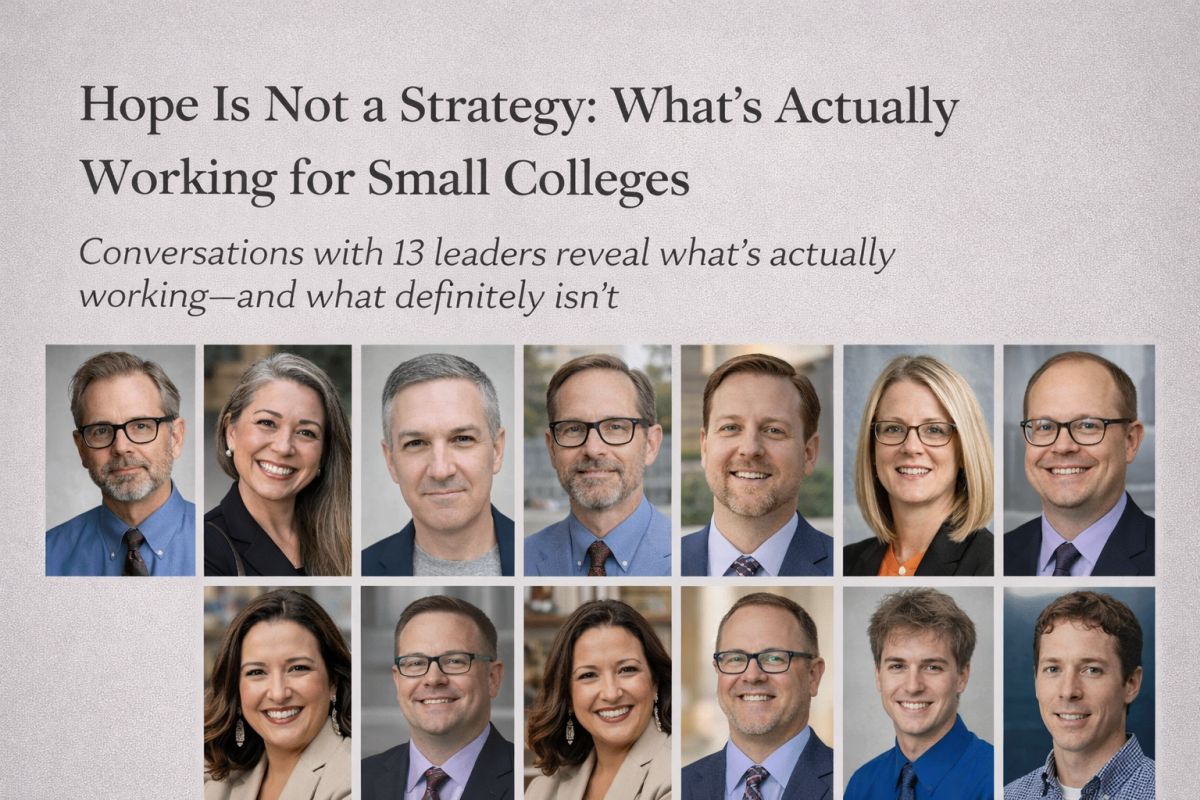
    Editor’s Note By Dean Hoke: This winter, Small College America completed its most ambitious season yet—13 conversations with presidents, consultants, and association leaders who are navigating the most turbulent period in higher education history. What emerged wasn’t theory or wishful thinking. It was a working playbook of what’s actually succeeding on the ground. This article synthesizes the five insights that matter most.

    When Hope Meets Reality

    Jeff Selingo doesn’t mince words.

    “Hope is not a strategy,” he said bluntly in Season 3 of Small College America.

    Jeff Selingo, a Best Selling Author and higher education advisor, named what every small college leader knows but hates to admit: the old playbook is dead. The demographic cliff isn’t coming—it’s here. Traditional enrollment models are broken. And no amount of wishful thinking about “riding out the storm” will change that.

    But here’s what surprised me across 13 conversations this season: nobody was sugarcoating reality, yet the conversations weren’t depressing.

    They were energizing.

    From Frank Shushok describing how Roanoke College built a K-12 lab school that creates a pipeline from kindergarten forward, to Teresa Parrott explaining why Grinnell took over a failing daycare center instead of issuing a mission statement about community engagement, from Gary Daynes doubling down on Salem College’s women’s mission when conventional wisdom said to go co-ed, to Kristen Soares navigating 2,500 California bills every legislative session—Season 3 captured something rare.

    Leaders who have moved past denial and into action.

    What emerged wasn’t abstract strategy consulting. It was concrete, operational intelligence from people doing the work. Here are the five insights that separate institutions that will thrive from those that won’t.

    1. Stop Marketing, Start Building Pipelines

    The traditional enrollment model—recruit high school seniors, get them to visit campus, send them glossy viewbooks, hope they choose you over 47 other colleges—is dead. Small colleges know this. But most are still acting like better marketing will solve it.

    It won’t.

    As Selingo pointed out, “At some point you have to come up with another segment of students if you’re tuition dependent because there just aren’t enough of those students to go around.”

    Translation: You cannot market your way out of a demographic crisis.

    The institutions seeing results aren’t the ones with slicker viewbooks or better social media strategies. They’re the ones building actual infrastructure for new student populations.

    What does that look like in practice?

    At Roanoke College, President Frank Shushok has approached enrollment not as a marketing problem, but as a pipeline design problem.

    Roanoke’s lab school creates a K–12 pathway while simultaneously solving a community need. Students who attend the lab school encounter the college early, come to trust it, and see it as part of their educational journey long before senior year. That’s not recruitment—that’s ecosystem building.

    The same logic shows up in Roanoke’s employer partnerships. The T-Mite Scholars program flips the traditional internship model: students complete two internships, receive a guaranteed job interview upon graduation, and receive tuition support from the employer. That’s not workforce development with a side of enrollment. That’s workforce development with enrollment as the byproduct.

    This pipeline mindset also appears at scale in California, as described by Kristen Soares, President of the Association of Independent California Colleges and Universities. California’s Associate Degree for Transfer (ADT) program creates guaranteed, transparent pathways from community colleges into four-year institutions—no credit games, no hidden requirements, no “we’ll evaluate your transcript and get back to you.” Just clear bridges that actually work for the students who need them most.

    Notice what these examples have in common: they aren’t marketing campaigns. They are operational partnerships designed to reduce friction and create consistent flows of students.

    As Shushok observed, “I think what you’re starting to see is some incredibly creative, adaptive, and agile institutions—because it requires a level of courage and resilience and tenacity.”

    The bottom line is straightforward: if your enrollment strategy is still primarily marketing-driven, you’re playing the wrong game. Build infrastructure. Create pipelines. Solve real community problems.
    The students will follow.

    2. Is Your Mission Statement Hurting You

    Teresa Parrott, Principal TVP Communications dropped what might be the most important insight of the entire season: small colleges need to shift “from mission to impact.”

    What she means matters right now.

    Most small college websites lead with mission statements like “We develop well-rounded citizens who think critically and serve their communities.”

    It’s lovely. It’s inspiring to people who already work at the college. And it’s entirely unpersuasive to everyone else.

    Legislators don’t care about your mission. Prospective students’ parents don’t care about your mission. Community members wondering why they should support you don’t care about your mission.

    They care about what you actually do.

    Compare generic mission language to Grinnell College’s approach. When their town’s daycare center was failing, Grinnell didn’t release a statement about their commitment to the community. They took over the daycare center. When the community golf course struggled, they stepped in to sustain it.

    As Parrott put it, “They are so embedded in their community that they really are almost a second arm of the government.”

    That’s not rhetoric. That’s concrete, documentable community impact.

    Or take Gary Daynes, President of Salem College insight about resource sharing at Salem: “It makes zero cents to build a football field. Seems like you could share with the local high school.”

    Simple. Obvious. Rarely done.

    But when colleges actually do it—by sharing theaters, athletic facilities, cultural resources, and programming—they become infrastructure their communities can’t imagine losing. They become politically and economically essential.

    The shift is this: Stop leading with what you believe. Start leading with what you do.

    Not “We believe in service.” Try “We trained 45% of the nurses in this region.”

    Not “We value community.” Try “We operate the only daycare center in town.”

    Not “We develop leaders.” Try “Our graduates run 23 local businesses and employ 400 people.”

    The institutions sufficiently community-embedded to make these claims are politically protected. The ones still leading with inspirational language become vulnerable the moment budgets get tight.

    The takeaway: Your communications team shouldn’t be writing mission statements. They should be documenting measurable community impact and leading with it everywhere.

    3. Lean Into What Makes You Different

    Selingo said it most directly: “There is more differentiation in higher education than we care to admit, but the presidents haven’t leaned into that enough.”

    Translation: You’re already different. You’re just afraid to say it loudly.

    Daynes decided to reaffirm its commitment to educating girls and women. That’s not chasing the market—it’s the opposite. But Daynes explained they looked at their data and realized the women’s college identity was a strength, not a liability they needed to downplay.

    Faith-based institutions are deepening their religious identities rather than treating them as mere historical affiliations that make the college vaguely Methodist or nominally Catholic.

    Health-focused campuses are building employer pipelines instead of trying to be liberal arts generalists who happen to have a nursing program.

    The pattern is clear: institutions trying to be less distinctive are struggling. Institutions doubling down on what makes them unique are finding traction.

    But here’s the critical part Daynes emphasized: distinctiveness has to be operational, not just marketing.

    If you’re a “community-engaged college,” you need actual programs embedded in the community—shared facilities, pipeline programs, workforce partnerships—not just a tagline on your website.

    If you’re “career-focused,” you need employer partnerships with real job placement data and students who can point to specific outcomes.

    If you’re faith-based, that identity needs to shape curriculum, student life, residential programs, and institutional decisions in ways students and families can see and experience.

    When distinctiveness is only branding, students and families see through it immediately. When it’s operational, it becomes your competitive advantage.

    The takeaway: Generic positioning is a slow death. Find what makes you genuinely different, operationalize it across your institution, and communicate it relentlessly.

    4. Real Partnerships vs. Press Releases

    Shushok nailed the mindset shift small colleges need to make: “Partnerships are everything in this moment. And once you get past that you’re competing with any of these entities, you start to realize, no, these are partners.”

    K-12 schools. Community colleges. Employers. Local governments. Hospitals. These aren’t competitors or nice-to-haves anymore. They’re essential infrastructure for institutional survival.

    But Daynes offered the crucial warning: “It’s easy to sign MOUs. It’s harder to sustain them.”

    Read that again.

    Translation: Your partnership announcements don’t mean anything.

    What matters is actual student flow. What matters is shared staffing. What matters is programs that operate year after year, not photo ops at signing ceremonies where everyone shakes hands and nobody follows through.

    Ask yourself right now: Do you know how many students transferred in from your community college “partners” last year? Do you have dedicated staff managing those relationships, or is it an extra duty for someone already overwhelmed?

    If you don’t know those numbers or don’t have dedicated staff, you don’t have partnerships. You have press releases.

    The partnerships that work have dedicated staffing to manage relationships and smooth student transitions, clear metrics measuring student flow rather than signed agreements, operational integration where partner institutions actually share resources, and financial skin in the game from all parties.

    Roanoke’s “Directed Tech” program with Virginia Tech counts the senior year as both undergraduate completion and the first year of a master’s degree. That’s not a partnership; that’s structural integration that changes the economics and value proposition for students.

    California’s ecosystem, where UC, CSU, community colleges, and independent institutions work together on workforce development, isn’t an inspirational collaboration story. It’s an economic necessity backed by 2,500+ pieces of legislation every two years, as Soares noted.

    When the state is writing hundreds of bills requiring coordination, you can’t fake it with a handshake and a press release.

    The bottom line: Count your partnerships that produce actual student flow and resource sharing. If that number is zero or close to it, stop announcing new partnerships and start making the ones you have actually work.

    5. Liberal Arts is Workforce Development (Stop Being Defensive About It)

    The false choice between liberal arts and workforce preparation came up in nearly every conversation. And every single guest rejected it.

    Shushok’s framing was the clearest: “Technical skills get you the first job. Human capacity skills enable 15 career reinventions.”

    Think about that.

    In a world where AI can write code, analyze data, generate reports, and automate technical tasks, what becomes more valuable—technical skills that become obsolete in five years, or the ability to adapt, think critically, communicate clearly, work across differences, and solve novel problems?

    As Shushok put it, “We might find that the liberal arts, the humanities, the small colleges, if we allow ourselves to be shaped by this moment, are exactly what the doctor ordered for the 21st century.”

    The problem: small colleges are still communicating defensively about the liberal arts instead of offensively.

    Stop saying “The liberal arts are ALSO important for careers.”

    Start saying, “The liberal arts are the ONLY preparation for a 40-year career in an unpredictable economy.”

    Stop apologizing for not being pre-professional.

    Start explaining why pre-professional education is increasingly obsolete in an age of AI and constant technological disruption.

    And most importantly: build the bridges so students can actually see the connection.

    That means boards that understand finance, politics, and operations—not just fundraising. CFO leadership that addresses structural challenges honestly. Political engagement that mobilizes entire institutions, not just government relations staff. And communications teams that function as impact documenters, not mission statement writers.

    Kristen Soares noted that 92% of California’s clinical workforce is trained at private colleges. That’s not despite the liberal arts foundation—it’s because of it.

    Nurses need critical thinking to make life-and-death decisions in ambiguous situations.

    Mental health counselors need empathy and adaptability to serve diverse communities.

    Teachers need communication skills and the ability to think on their feet.

    The liberal arts aren’t tangential to workforce needs. They’re central. But you have to stop defending them and start operationalizing the connection in ways students, families, and employers can see.

    The takeaway: The liberal arts are perfectly suited for workforce needs. Stop defending. Start operationalizing. Build the bridges.

    So what do you actually DO with all this?

    Season 3 didn’t just surface problems—it revealed a working playbook. Here’s what leaders who are successfully navigating this moment have in common:

    • They’re building infrastructure for new student populations instead.
    • They’re documenting measurable community impact and leading with it.
    • They’re deepening what makes them genuinely distinctive.
    • They’re measuring student flow and resource sharing.
    • They’re operationalizing the connection to careers.

    Shushok’s insight about “recalibration versus balance” might be the most critical leadership lesson of the season. As he put it, “Balance is not a destination, but constant recalibration.”

    Small college leadership today isn’t about finding the right strategy and executing it for five years. It’s about continuous adjustment based on what’s actually working.

    That means:

    • Boards that understand finance, politics, and operations—not just fundraising

    • CFO leadership that addresses structural challenges honestly

    • Political engagement that mobilizes entire institutions, not just government relations staff

    • Communications teams that function as impact documenters, not mission statement writers

    As Daynes reflected, “I love small colleges. There are folks of intense gifts amongst the faculty and staff who have chosen to be the places that they are.”

    That’s the source of optimism throughout Season 3.

    Not naive hope that things will get better on their own.

    But grounded confidence in devoted people willing to do hard, creative work.

    Jeff Selingo’s blunt assessment—”Hope is not a strategy”—wasn’t meant to demoralize. It was meant to liberate.

    Small colleges that thrive in the next decade will  be the ones that:

    • Build operational infrastructure for new student populations

    • Document and communicate measurable community impact

    • Operationalize distinctiveness throughout the institution

    • Create partnerships that produce actual student flow

    • Connect liberal arts to career outcomes without defensiveness

    • Recalibrate constantly based on what’s working

    The leaders in Season 3 aren’t waiting for permission or hoping for a miracle. They’re building lab schools. They’re taking over daycare centers. They’re sharing facilities with high schools. They’re creating guaranteed pathways to graduate programs. They’re documenting their impact and leading with it.

    They’re doing the work.

    And they’re proving that hope—real, grounded hope based on action rather than wishful thinking—comes from building things that work.

    Looking Forward: Three Conversations to Start This Week

    If you’re a president, provost, trustee, or senior leader, here are three conversations you can start right now if you haven’t already done so :

    1. With your enrollment team: Ask them to map every actual pipeline you have for new students—not marketing campaigns, but structural pathways that produce consistent student flow. If the list is short or non-existent, that’s your answer. Start building infrastructure, not marketing plans.

    2. With your communications team: Ask them to document your measurable community impact in the last 12 months. Not what you believe or aspire to do—what you actually did. How many jobs did you create? How many nurses did you train? What facilities do you share? What problems did you solve? If the answer is vague or mission-statement-heavy, you have work to do.

    3. With your board: Present them with a simple question: “If we could only communicate three things about our institution to prospective students, legislators, and community members, what would they be?” If the answers are about mission and values rather than concrete impact and distinctive programs, you need to shift the conversation.

    These aren’t theoretical exercises. They’re diagnostic tools that reveal whether your institution is still operating from the old playbook or building the new one.

    Selingo was right: hope is not a strategy. But action, infrastructure, partnerships, impact, and constant recalibration is a playbook that works.

    Season 3 of Small College America featured conversations with 13 leaders in the field of higher education. Thanks to everyone who participated, and especially my co-host Kent Barnds and my Producer and lovely wife Nancy Hoke.

    • Raj Bellani, Chief of Staff, Denison College
    • Gary Daynes, President, Salem College
    • Josh Hibbard, Vice President of Enrollment Management, Whitworth University
    • Dean McCurdy, President, Colby Sawyer College
    • Jon Nichols, Faculty member and author
    • Teresa Parrott, Principal TVP Communications
    • Karen Petersen, President, Hendrix College
    • Michael Scarlett, Professor of Education, Augustana College
    • Jeff Selingo, Best Selling Author and higher education advisor
    • Frank Shushok, President, Roanoke College
    • Kristen Soares, President, Association of Independent California Colleges and Universities
    • Gregor Thuswaldner, Provost, La Roche University
    • Jeremiah Williams, Professor of Physics, Wittenberg University

    The conversations continue.

    Small College America returns in February with a new season featuring candid discussions with presidents, faculty, and leaders navigating the most consequential moment in higher education.

    Hosted by Dean Hoke and Kent Barnds, the series explores the evolving role of small colleges, their impact on communities, and the strategies leaders are using to adapt and endure.

    Listen or watch past episodes on Apple, Spotify, YouTube, and many others, or preview what’s coming next, and follow the series at www.smallcollegeamerica.net.

    Source link

  • Indiana High Schoolers Set Record Graduation Rate in 2025 – The 74

    Indiana High Schoolers Set Record Graduation Rate in 2025 – The 74


    Get stories like this delivered straight to your inbox. Sign up for The 74 Newsletter

    Nearly 92% of Indiana’s high school seniors graduated in 2025, setting the highest graduation rate on record, the Indiana Department of Education announced Monday.

    “Today’s record-high graduation rate is a testament to the hard work of Indiana’s students, families, and educators,” Gov. Mike Braun said in a news release.

    “While high school graduation marks the end of a student’s K-12 journey, our schools play an essential role in preparing students for all that comes next, whether that’s going to college, starting a career, or joining the military,” he continued. “This strong improvement in our state’s graduation rate shows that when we focus on academic excellence and establish clear, personalized pathways, our students thrive.”

    The 91.83% graduation rate bested the 90.23% record set in 2024 by 1.6 percentage points.

    It represents the third straight year of post-pandemic improvement kicked off in 2023, when 88.98% graduated. Seniors recorded a decade-low graduation rate of 86.65% in 2022.

    “As we continue to scale the new Indiana diploma and readiness seals statewide, we will not only strengthen the value of high school and help more students graduate, we will ensure that they are prepared to succeed in whatever path they choose for their future,” state Education Secretary Katie Jenner said.

    Numerous student populations improved in the results released Tuesday.

    Almost 87% of Black students graduated in 2025, up 3 percentage points from the previous year, along with nearly 90% of Hispanic students, in a boost of 2 percentage points. White students improved to 93%, or by about 1.5 percentage points, and their multiracial classmates logged a graduation rate of 88%, up by 1 percentage point.

    Seniors learning English, receiving free and reduced-price meals, and in special education also graduated at higher rates than the year prior — but still lagged their native speaker, paid lunch and general education peers.

    The rate of students who graduated without waivers additionally cleared 90%. Students who do not complete or pass some graduation requirements can still qualify for a diploma if they demonstrate knowledge or skill.

    The waivers are intended to help students with special circumstances, like those who’ve transferred to a new school or who have attempted to pass competency tests at least three times.

    State education and policy leaders have for years sought to lower dependence on waivers, including by setting caps on the percentage of graduation waivers that can be counted toward a school’s state and local graduation rate. They took effect with the 2024 cohort.

    Non-public schools outperformed their public counterparts by about 1 percentage point — 93% versus 92% — but the differences between traditional public and public charter schools were not reported. In the 2024 results, about 93% of students at traditional public schools graduated as opposed to just 59% of students at public charter schools.

    Indiana’s federal graduation rate increased, almost hitting 90% compared to 2024’s 89%. The rates are calculated differently because of differences between state and federal accountability models, according to IDOE.

    Indiana Capital Chronicle is part of States Newsroom, a nonprofit news network supported by grants and a coalition of donors as a 501c(3) public charity. Indiana Capital Chronicle maintains editorial independence. Contact Editor Niki Kelly for questions: [email protected].


    Did you use this article in your work?

    We’d love to hear how The 74’s reporting is helping educators, researchers, and policymakers. Tell us how

    Source link

  • WEEKEND READING: Why not more?

    WEEKEND READING: Why not more?

    This blog was kindly authored by Professor Sir Chris Husbands, Director of Higher Futures and a HEPI Trustee. He was previously the Vice-Chancellor of Sheffield Hallam University.

    When the Times Higher Education considered those who had shaped higher education in 2025, it gave top billing to Jane Harrington, Vice-Chancellor of the University of Greenwich. And understandably so: along with Georgina Randsley de Moura, the Kent vice-chancellor, Jane is leading the merger of Greenwich and Kent to form what will be the UK’s first multi-university group. The new entity won’t necessarily stop at two universities, since it has been set up explicitly to incorporate others later. None of this should be a surprise. English universities continue to face severe challenges. The most recent OfS assessment is downbeat about the sector’s financial prospects. The October 2025 Post-16 white paper proposal to raise tuition fees in line with inflation has not really alleviated the problems: the measure to be used for indexation has not been identified, and for many institutions, that makes a significant difference. Moreover, indexation begins from a fee level which has been eroded in real terms over the last thirteen years. The real-terms value of the base unit of resource for indexation is roughly the same as it was in 1998 when top-up fees were first introduced. And thirdly, what the White Paper gives with one hand – fee indexation – it takes away with another in the form of the international student levy. The challenges remain.

    The White Paper envisages consolidation as one solution, asking ‘institutions to share resources and infrastructure, minimising duplication of effort’.  It wants ‘more consolidation and formal collaboration in the sector, with the result that institutions will be stronger and more financially sustainable.’ The Greenwich-Kent announcement followed a flurry of interest in what KPMG and Mills called ‘radical efficiency’ measures from shared services to deeper collaboration to full merger. The expectation is that the future of English higher education involves fewer institutions, greater specialisation and more consolidation.

    The higher education rumour mill has been spinning: a takeover here, a new group there, a university supposedly absorbing an further education college, a Russell Group member considering merger with its modern neighbour, all of them involving, as a long-running soap opera once put it, ‘neighbours becoming [more than] good friends.’ But repeatedly, rumours are either ill-founded or conversations collapse. Of course, mergers are difficult – and I should know, as I’ve led two of them, merging two higher education institutions and two sector agencies. But given the scale of the challenges, the surprise is that more has not happened. Understanding why this is may be one route to unlocking wider cultural change across the sector.

    Consolidation has been slow for several possible reasons. One, which could date this comment quickly, is that institutions may have been waiting for the White Paper to see the government’s intentions. With the White Paper out, activity may speed up. But this seems unlikely. Although the government’s aspirations for consolidation and specialisation are clear, it offers weak change mechanisms. A reshaping of research funding is the clearest policy shift, but there are few other measures to drive ‘consolidation and formal collaboration’. There’s no transformation fund, no new policy levers, no active market-shaping.

    Other reasons seem more compelling. One is the embedded culture of leadership and governance. Hyper-competitiveness has driven a robustly independent leadership culture, which means few leaders are well-attuned to the way to make collaboration work effectively. Boards are cautious. Universities have a range of governance forms; some are chartered, some are higher education corporations, and more recent foundations have other forms. The overwhelming majority have charitable status, with a board of governors owing fiduciary responsibilities to their own institution. In most cases, governors assume that their responsibility is to ensure that the university survives its current form, perhaps especially when the university bears the name of the place in which it is located: local pride matters. In fact, the responsibility of leaders and governors is to realise the objects of the charity, but the inclination to see their duty as being to the university rather than its objects is a barrier to change.

    A second explanation lies in regulation. The Office for Students’ new Strategy commits it to being collaborative, and it has said that it will not erect unnecessary barriers to consolidation. But the detail is complicated. Mergers between (say) stronger and weaker institutions may nevertheless create concerns about student outcomes (the OfS B3 conditions), whilst mergers between two struggling institutions are more likely to be problematic for B3 conditions. Without regulatory bridging arrangements, the worry – perhaps especially amongst cautious lawyers advising institutions – is that a merger brings regulatory risk. And the OfS is not the only regulator. Chartered institutions require Privy Council approval for governance changes. Cross-sector ‘vertical’ mergers, such as between higher education and further education institutions, which have potential in a more ‘tertiary’ world, involve overlapping and different regulatory regimes. Charity Commission approval is another potential hurdle

    Thirdly, there is a difference between mergers in for-profit and not-for-profit organisations. In the commercial world, mergers are almost always designed to increase shareholder return. The merger unlocks additional investment, capabilities, assets or routes to market expansion, which means higher financial returns. Even where a successful company takes on distressed assets, there are gains to be realised through intellectual property rights or the value in the distressed company’s assets. The initial costs of the merger – digital and management systems, restructuring – can either be met from reserves and the gains realised later, or by raising equity. Although universities are formally private sector institutions, in this respect, they resemble public institutions: they are not-for-profit and have charitable objectives. In other parts of the public sector, for example, further education colleges or academy trusts, mergers are often forced by the FE Commissioner or the Regional Schools Commissioner. Some public investment is often made available to handle transition costs – essentially performing the function of the financial markets in private sector mergers.

    If this analysis is right, it helps to explain why, despite the challenges, cultural, financial and regulatory concerns are slowing the radical changes– continue the pop culture references here and quote the Spice Girls – ‘when two become one.’ Understandably, universities believe that they need to solve their problems through some combination of restructuring, asset disposal, workforce reform or portfolio reshaping. Of course, mergers can happen, and given the combination of the push of financial pressures and the pull of a new policy framework, 2026 may unlock more activity in both vertical (HE/FE) and horizontal (HE/HE) mergers. But we shouldn’t hold our breath.

    The government could almost certainly have accelerated structural change through some sort of transformation fund. In the absence of that, others may bide their time and watch the Greenwich/Kent experience. It would be a missed opportunity if that is all they do.

    Mergers may be challenging, but the difficulties facing so many universities call for radical cultural and leadership change: collaborative, cross-institutional and, above all, learner-centred thinking. Institutions need the leadership confidence to engage with deep structural collaboration. The elements for that are increasingly clear, involving collaboration to pool elements of strategy and organisation, both across HE and deep into the other elements of post-18 education; and there are valuable steps that can be taken without committing to full merger. 2026 provides a much-needed opportunity to test and shape such different approaches and models. Indeed, without such bold thinking, the opportunity to create a more coherent and effective system will not be realised.

    Get our updates via email

    Enter your email address to subscribe to this blog and receive notifications of new posts by email.

    The post WEEKEND READING: Why not more? appeared first on HEPI.

    Source link