Blog

  • Test yourself on the past week’s K-12 news

    Test yourself on the past week’s K-12 news

    This audio is auto-generated. Please let us know if you have feedback.

    How well did you keep up with this week’s developments in K-12 education? To find out, take our five-question quiz below. Then, share your score by tagging us on social media with #K12DivePopQuiz.


    Source link

  • 2 flagship universities select leaders after abrupt resignations

    2 flagship universities select leaders after abrupt resignations

    The end of 2025 didn’t just usher in winter break but also major leadership changes.

    Two East Coast flagships, the University of Virginia and the University of Delaware, named new presidents, each of whom took office on Jan. 1. But UVA’s decision to name a president in December defied the wishes of Gov.-elect Abigail Spanberger, potentially setting the stage for contentious relations between her and the university’s board.

    At least two religious institutions also announced leadership transitions last month, some making mid-academic year pivots.

    Below, we’re rounding up a selection of last month’s most notable college leadership changes.

    President: Brian Konkol
    Institution: Valparaiso University
    Coming or going? Coming

    Valparaiso University on Dec. 2 selected Brian Konkol as its new president. Konkol joins the Lutheran institution from Syracuse University, where he served as vice president, dean and professor.

    Konkol assumed the role on Jan. 1.

    Like many small religious institutions, Valparaiso’s finances have been shaky in recent years. 

    The university implemented a suite of cuts in 2024, eliminating over two dozen academic programs with low enrollment and nixing an undisclosed number of faculty positions. 

    Valparaiso’s last leader, José Padilla, said at the time that the cuts were “not solely a cost cutting initiative” and were also intended to “meet the expectations of our students and the demands of the market.” Six months later, Padilla announced he would resign when his contract expired on Dec. 31.

    S&P Global Ratings in May gave Valparaiso’s bonds a BB+ rating, which reflects some credit risk. The university’s attempt to sell $54 million in bonds faced delays, according to Bloomberg, but they went through in July.


    President: Kathleen Getz
    Institution: Mercyhurst University
    Coming or going? Going

    Mercyhurst University President Kathleen Getz will retire at the end of June, the Catholic institution announced Dec. 2.

    Under Getz, the Pennsylvania university served as a teach-out option for students who attended Notre Dame College of Ohio, a nearby religious institution that shuttered in 2024.

    Mercyhurst also moved up to NCAA’s Division 1. Getz said at the time that the transition would allow the small private college to collaborate and compete with “universities and athletic programs in new and larger markets.”

    The university also made staffing cuts, though they were less dramatic than those at other peer colleges. It cut five administrative and staff positions in June. Getz told the Erie Times-News that the cuts were not indicative of larger financial struggles at the university.

    Mercyhurst’s board selected David Livingston as the institution’s interim president for a term of two years, beginning when Getz steps down. Livingston is a former Mercyhurst faculty member and administrator who more recently led Lourdes and Lewis universities.

    President: Greg Cant
    Institution: Wilkes University
    Coming or going? Going

    Greg Cant will retire as Wilkes University’s president in August, per a Dec. 8 statement from the university.

    The announcement came just days after Cant informed university stakeholders that the private Pennsylvania institution had implemented a plan that had closed a roughly $7 million budget deficit.

    The deficit first became public knowledge when The Citizens’ Voice obtained a copy of an October letter to the campus community detailing the shortfall, which attributed it in part to a “breakdown in process” and “failure in leadership.” The projected gap followed a $2.8 million deficit the previous year that left officials “surprised,” according to The Citizens’ Voice.

    The university faced student protests in the fall demanding more transparency from administrators. Wilkes last month did not publicly share details about how it had addressed the budget gap, but a university spokesperson told The Citizens’ Voice it will “share any additional updates when they are available.”

    Effective immediately, Wilkes’ senior vice president and provost, David Ward, assumed the role of chief operating officer and provost “to support the University in this time of leadership transition,” the university said in its Dec. 8 release.

    President: James Clements
    Institution: Clemson University
    Coming or going? Going

    Clemson University President James Clements announced on Dec. 9 that he would retire at the end of the month, after leading the South Carolina institution for 12 years. The abrupt notice came after Clemson’s board approved a five-year contract extension for Clements in October 2024.

    The public research university has repeatedly been in the public eye over the last year, both for its financial woes and its responses to political pressure. 

    Clemson froze all spending that wasn’t “mission critical,” restricted employee travel and suspended hiring amid reports it needed to cut $63 million from its budget. According to an email shared with The Post and Courier, the university said it was not facing a deficit and no jobs were in danger.

    The university also froze its in-state tuition rate for undergraduates to secure more state funding.

    Source link

  • 5 tips for educators using video

    5 tips for educators using video

    Key points:

    When you need to fix your sink, learn how to use AI, or cook up a new recipe, chances are you searched on YouTube, TikTok, Instagram, or even Facebook–and found a video, watched it, paused it, rewound it, and successfully accomplished your goal. Why? Videos allow you to get the big picture, and then pause, rewind, and re-watch the instruction as many times as you want, at your own pace.  Video-based instruction offers a hands-free, multichannel (sight and sound) learning experience. Creating educational videos isn’t an “extra” for creating instruction in today’s world; it’s essential.

    As an educator, over the past 30 years, I’ve created thousands of instructional videos. I started creating videos at Bloomsburg University early in my career so I could reinforce key concepts, visually present ideas, and provide step-by-step instruction on software functionality to my students. Since those early beginnings, I’ve had the chance to create video-based courses for Lynda.com (now LinkedIn Learning) and for my YouTube channel.

    Creating instructional videos has saved me time, expanded my reach, and allowed me to have more impact on my students.

    Tips

    Creating educational videos over the years has taught me a number of key lessons that can help you, too, to create impactful and effective instructional videos.

    Be yourself and have fun

    The first rule is to not overthink it. You are not giving a performance; you are connecting with your students. In your instructional video, talk directly to your students and connect with them. The video should be an extension of your personality. If you tell silly jokes in class, tell silly jokes in the video. You want your authentic voice, your expressions, and your energy in the videos you create.

    And don’t worry about mistakes. When I first did Lynda.com courses, any small mistake I made meant we had to redo the take. However, over the years, the feedback I’ve received on the videos across LinkedIn Learning indicated that flawless performances were not the way to go because they didn’t feel “real.” Real people make mistakes, misspeak, and mispronounce words. Students want to connect with you, not with flawless editing. If you stumble over a word, laugh it off and keep going. The authenticity makes the student feel like you’re right there with them. If you watch some of my current LinkedIn Learning courses, you’ll notice some mistakes, and that’s okay–it’s a connection, not a distraction.

    Speak with the students, don’t lecture

    Video gives you the chance to have an authentic connection with the student as if you were sitting across the desk from them, having a friendly but informative chat. When filming, look directly into the camera, but don’t stare–keep it natural. In actual conversations, two people don’t stare at each other, they occasionally look away or look to the side. Keep that in mind as you are recording. Also make sure you smile, are animated, and seem excited to share your knowledge. Keep your tone conversational, not formal. Don’t slip into “lecture mode.” When you look directly into the camera and speak directly to the student, you create a sense of intimacy, presence, and connection. That simple shift from a lecture mindset to conversation will make the video far more impactful and help the learning to stick.

    Record in short bursts

    You don’t have to record a one-hour lecture all at once. In fact, don’t!  A marathon recording session isn’t good for you. It creates fatigue, mistakes, and the dreaded “do-over” spiral where one slip-up makes you want to restart the entire video. Instead, record in short bursts, breaking your content into segments. Usually, I try to record only about four to five minutes at a time.  The beauty of this technique is that if it’s completely a mess and needs a total “do over,” you only need to re-record a few minutes, not the entire lecture. This is a lifesaver. Before I began using this technique, I dreaded trying to get an entire one-hour lecture perfect for the recording, even though I was rarely perfect in delivering it in class. But the pressure, because it was recorded, was almost overwhelming.

    Now, I record in small segments and either put them all together after I’ve recorded them individually or present them to students individually. The advantage of individually recorded videos for students is that it makes the content easier to learn. They can re-watch the exact piece they struggled with instead of hunting through an hour-long video to find just what they need.

    Keep it moving

    A word of caution: We’ve all seen those videos. You know the ones: A tiny talking head hovers in the corner, reading every bullet point like it’s the audiobook version of the slide while the same slide just sits there for 15 minutes with no movement and no animation–not even a text flying in from the left. Ugh. Don’t let your visuals sit there like wallpaper. Instead, strive for movement. About every 30 seconds, give learners something new to look at. That could mean switching to the next slide, drawing live on a whiteboard, cutting to you speaking and then back to the slide, or animating an illustration to show movement. The point is that motion grabs attention. For a video, cut down your wall-of-text slides. Use fewer words and more slides. If you have 50 words crammed on one slide, split it into three slides. Insert an image, a chart, or even a simple sketch. If you’re teaching software, demonstrate it on screen instead of describing it in words. If you’re explaining a process, illustrate the steps as you go. The more movement, the more likely you are to hold the learner’s attention.

    Keep production simple

    The good news about creating educational videos is that you don’t need a big budget or a film crew to get started. All you need is a camera, a good microphone, and a simple video creation tool. Now, I would advise not using your laptop’s built-in camera or microphone. They don’t do the job well. You don’t want a grainy, pixelated picture or muffled audio. They make it too hard for students to focus and even harder for them to stay engaged. For video, I recommend using an external webcam. Even a modest one is a huge step up from what’s baked into most PCs. For audio, go with an external microphone, or even a good-quality headset. For the video tool, I have not found a simpler or easier-to-use tool than Camtasia’s free online, cloud-based tool. The free version lets you record your screen, capture your voice, do slight edits, and add backgrounds.  It is more than enough to create clear, useful videos that your students can actually learn from. Remember, the goal isn’t Hollywood production. You want clear, effective, and authentic instructional videos.

    By using these five tips, educators can create instructional videos to save time, expand their reach, and create greater impacts on their students. Grab a good camera, a decent headset, and free video software, and create your first instructional video. Just simply start. You’ll wonder why you waited so long.

    Latest posts by eSchool Media Contributors (see all)

    Source link

  • South Dakota Adopts Post-Tenure Review

    South Dakota Adopts Post-Tenure Review

    Faculty in South Dakota could lose their tenure status if they don’t meet expectations, per a new policy the South Dakota Board of Regents approved in December.

    It requires tenured faculty at the state’s six public higher learning institutions to undergo a performance review every five years, beginning during the 2026–27 academic year. While all faculty members already receive an annual performance evaluation by their immediate supervisor, the new policy adds another layer of review and considers five years’ worth of those evaluations to rank a professor’s performance.

    Approval of the policy makes South Dakota the latest state to enact a post-tenure review policy. Since 2020, numerous other states—including Florida, Georgia, Kentucky and Ohio—have done the same, whereas many others have weakened tenure through various other means. Indiana, for example, passed a law in 2024 that requires colleges to conduct post-tenure reviews every five years and deny tenure to faculty unlikely to foster “intellectual diversity.”

    South Dakota’s new tenure-review policy is part of the board’s response to the “immense pressure, from both internal and external forces,” on the national higher education landscape, according to an October board document. “These pressures include accountability (accreditors, state legislatures, and federal government), educational demand and market change, resource constraints, continuous improvement, incentivizing quality instruction, research, and service, etc.”

    Under the policy, if a faculty member received an annual performance rating of “does not meet expectations” or was placed on a faculty improvement plan in the previous five years, “tenure will be non-renewed, and the faculty member will be issued a one-year term contract for the following academic year.” The policy notes that the employee would still be eligible to apply for nontenurable positions within the system.

    “[The policy] really reinforces our commitment to excellence when it comes to our faculty, the work that they do in education, teaching, service and research, while also reinforcing our commitment to continued accountability and closing the loop,” Pam Carriveau, provost and vice president for academic affairs of Black Hills State University, told the board before it approved the measure. “When we have faculty that are performing well and continue to perform well even past receiving tenure, this process allows us to recognize and reinforce that.”

    ‘End of Tenure’ in South Dakota

    But as Mark Criley, a senior program officer for the department of academic freedom, tenure and governance at the American Association of University Professors, interprets the policy, professors who don’t pass the post-tenure review don’t get a hearing in front of a panel of their peers, in opposition to the AAUP’s recommended regulations. (The board did not respond to a request for clarification about that interpretation, though the policy makes no mention of a hearing.)

    “If [tenured faculty can be dismissed] without a hearing at which the administration has to make the case before an elected body of peers, then that’s effectively the end of tenure in South Dakota,” Criley told Inside Higher Ed Thursday. “Post-tenure reviews are becoming increasingly common, and for the most part, they’re redundant. Faculty are already reviewed. Being tenured doesn’t mean you can’t be fired. There is accountability, but there needs to be those types of due process protections.”

    The erosion of tenure protections was on display this fall when universities across the country, including the University of South Dakota, suspended or fired dozens of professors who made public comments about far-right podcaster Charlie Kirk in the wake of his shooting.

    However, the board was considering post-tenure review prior to Kirk’s death as part of a broader plan to help “align institutional compensation practices with higher education market standards and evolving best practices,” according to board documents. Last summer, it charged an advisory committee—composed of one faculty member and 11 administrators—with developing procedures aimed at “incentivizing quality faculty, while providing the accountability and assurances necessary to safeguard tenure,” which resulted in the post-tenure review policy.

    While the policy does not specify the makeup of the review committee, noting that “composition and size may vary by institution,” it requires that a review committee “not be composed solely of academic administration” that completes annual performance evaluations. The rating scale for the post-tenure review includes three categories—exceeds expectations, meets expectations and does not meet expectations—though individual institutions are responsible for developing them within certain guidelines outlined by the policy.

    Randy Frederick, board secretary, said the last part is designed to mitigate government overreach, acknowledging that different institutions and departments have varied expectations that the board doesn’t have expertise on.

    “Make no mistake, this is government regulation, and over–government regulation is a waste and it is profligacy,” Frederick said at the December meeting. That’s why, he added “all the blanks of the review will be filled in by the individual institutions.”

    Making sure the review metrics are specific and clear is also key to preserving academic freedom, Michael Card, a political science professor emeritus at USD, told South Dakota Public Broadcasting.

    “The three categories or buckets of our responsibilities are, the obvious one, teaching, but we are also to do research and then the other one is service to the institution and or your profession,” Card said. “Those could be spelled out more, even on an annual basis, and they’re often not.”

    But even with those details in place, the policy alone has the potential to incite fear and cheapen the learning environment at South Dakota’s colleges and universities, said Criley of the AAUP.

    “Teachers’ working conditions are students’ learning conditions,” he said. “When you have perpetually probationary faculty without security constantly looking over their shoulders, fearful of teaching controversial subjects, doing controversial research or expressing unfavorable views about institutional governance, students are not well served.”

    Source link

  • Temple Research Lab Improves Student Athlete Support

    Temple Research Lab Improves Student Athlete Support

    As the landscape of college athletics continues to shift, Temple University is experimenting with a new initiative that embeds academic research into the day-to-day operations of its athletics department.

    Launched last month, the Athletic Innovation, Research and Education Lab formalizes a partnership between the School of Sport, Tourism and Hospitality Management (STHM) and Temple Athletics.

    The AIRE Lab functions as both a research center and a practical hub, aiming to improve program management and student athletes’ development through evidence-based solutions.

    Jonathan Howe, an assistant professor at STHM and AIRE Lab co-director, said supporting the student-athlete experience is especially important at an institution like Temple University, which has fewer resources for name, image and likeness and revenue sharing than larger schools.

    “We’re able to engage in research and leverage university resources in a way that the athletics department may not traditionally be able to do,” Howe said.

    Elizabeth Taylor, an associate professor at STHM and AIRE Lab co-director, emphasized the importance of data-driven decision-making.

    “The folks who work in student athlete development may not have the capacity to do their full-time jobs while also staying up-to-date on the literature or evaluating the impact and effectiveness of the programs they offer,” Taylor said.

    She added that the goal is to “connect with people on campus who are already doing this work and share resources instead of recreating the wheel or paying someone from outside the university.”

    State of play: The launch of the AIRE Lab comes amid rapid changes in college athletics, including the rise of NIL compensation, evolving transfer rules and ongoing debates over athlete eligibility and governance. Taylor and Howe said these shifts have increased the need for institutions to understand how policy, culture and organizational decisions affect student athletes.

    “The additional opportunities through NIL and revenue-sharing create more time demands on student athletes,” Taylor said, noting that potential brand deals can complicate efforts to balance practices and competitions with classes, extracurriculars and internships.

    “What the research shows us is that they’re already strapped for time and what comes with that is stress, anxiety and mental health challenges,” she added.

    Transfer rules can further complicate the student athlete experience, particularly for athletes arriving from other institutions, Howe said. “Navigating the academic setting is a lot for athletes who may be transferring in or may have a lucrative NIL deal, so academics may be put on the back burner,” he said.

    To bridge the gap between research and daily operations, the athletics department appointed two staff members as lab practitioners to help translate research into practice.

    “Everything is changing by the second, and student athletes are having to navigate these changes,” Howe said. “So how can we provide a system that identifies the most beneficial programming to help athletes be as successful as possible in their professional pursuits once they leave campus?”

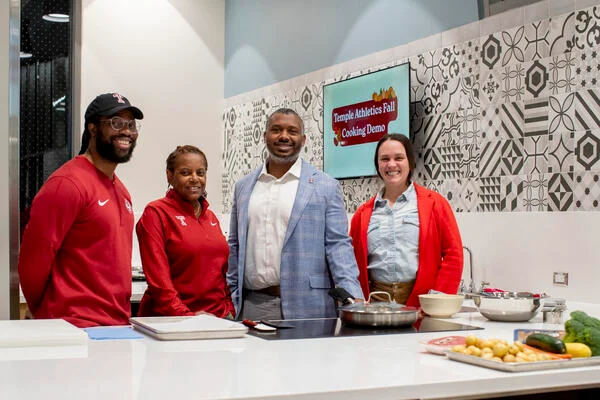
    In practice: One of the lab’s first initiatives was a cooking demonstration held at Temple University’s public health school. The session was designed to help student athletes learn how to prepare simple, nutritious meals.

    Taylor said the goal was to encourage student athletes to make practical, healthy choices and develop skills they can use outside of structured team meals.

    “The idea behind the cooking demonstration came from a research article on the experiences of college athletes, and one of the things that the athletes talked about is how so much of their life is planned out for them,” said Taylor. She added that while what student athletes eat and how they work out is often prescribed, they aren’t necessarily taught why they’re eating certain foods or doing specific workouts in the weight room.

    “It was a great experience for them to learn more about cooking safely and making healthy meals,” she added, noting that over 20 student athletes participated in the session.

    What’s next: Looking ahead, Howe said he hopes the lab will serve as a model for other institutions seeking to better integrate research, student athlete well-being and athletics administration.

    “We want to continue leveraging institutional, federal and state resources to provide athletes with opportunities they normally wouldn’t get, especially at a time when higher education budgets are being cut,” Howe said.

    “For me, the AIRE Lab allows us to break down some of the long-standing barriers we’ve had at the higher education level. Just because the budget is cut doesn’t mean we have to eliminate programs,” he said.

    Get more content like this directly to your inbox. Subscribe here.

    Source link

  • Lender Presses Saint Augustine’s to Oust Trustees

    Lender Presses Saint Augustine’s to Oust Trustees

    Two trustees appear to be out at Saint Augustine’s University after a lender offered the cash-strapped institution a financial lifeline contingent on the removal of certain board members.

    Self-Help Ventures agreed to take on at least $7 million in debt owed to another company and consider providing up to $20 million in desperately needed financing for the cash-strapped university in the future, WRAL reported. But Self-Help wanted the historically Black university to remove Brian Boulware and James Perry, both former board chairmen who have been criticized for SAU’s struggles as the private institution in North Carolina has teetered on the brink of closure since late 2023.

    Perry told WRAL that his term had expired. Boulware has been removed from the board roster on the SAU website but told the TV station that he had not been informed of any changes. Current board leadership, however, appeared to sign off on the terms of the deal, according to emails obtained by WRAL in which Chair Sophie Gibson signaled support.

    “History will record what this board did—or failed to do—at this moment,” she wrote.

    Critics had been calling for Boulware and Perry to step down or be removed for more than a year, accusing them of failing in their fiduciary duties as SAU has struggled to remain open. At the same time, the university has been on an accreditation roller coaster. Since December 2023, SAU has been stripped of accreditation twice, only to regain it via the courts on both occasions.

    SAU currently remains accredited after a legal reprieve in August.

    Despite its financial challenges, the university has expressed interest in the Trump administration’s proposed “Compact for Academic Excellence in Higher Education.” The proposed compact would give signatories an advantage in attracting federal research funding but come with sweeping restrictions on academic freedom and institutional autonomy.

    SAU officials did not respond to a request for comment from Inside Higher Ed.

    Source link

  • Parenting Students Bear the Brunt of Federal Cuts

    Parenting Students Bear the Brunt of Federal Cuts

    Photo illustration by Justin Morrison/Inside Higher Ed | RichVintage/E+/Getty Images

    Cuts to federal funding that supported students of color and undocumented students dominated headlines in the first year of the Trump administration. But advocates for student parents say the administration has gutted benefit programs these students rely on, leaving a fifth of the country’s college students vulnerable to financial hardship or even at risk of stopping out.

    Federal funds for programs providing a critical element of support for student parents, childcare, could be frozen or canceled. In a recent example, the U.S. Department of Health and Human Services froze billions of dollars in childcare and family assistance funds to five Democrat-led states, citing fraud concerns. About $2.4 billion in Childcare and Development Fund grants and $7.35 billion in Temporary Assistance for Needy Families funds are on the line.

    The Education Department also nixed grants for on-campus childcare at more than a dozen colleges this summer; ED officials claimed the institutions didn’t hire childcare staff based on merit or hired staff who taught gender identity and racial justice to children. Funding for the federal grant program Child Care Access Means Parents in School (CCAMPIS) was already uncertain after Trump recommended axing it in his proposed budget for 2026.

    Childcare “is a lifeline for parenting college students,” said Nicole Lynn Lewis, a former parenting student and founder and CEO of Generation Hope, a nonprofit that supports student parents. “To have that support significantly reduced, frozen, taken away, attacked, threatened—that is a major blow to families’ ability to excel and to be able to experience economic mobility.”

    In their efforts to close the Department of Education, officials also shuffled responsibility for CCAMPIS over to HHS. The move risks adding new layers of confusion and bureaucracy to a program that already only reaches a small fraction of parenting students, Lewis said. Parents make up a fifth of the tens of millions of college students across the country, and CCAMPIS serves about 11,000 of them.

    But childcare isn’t the only worry. Advocates say recent cuts to public benefits are also a major concern for parenting students.

    The One Big Beautiful Bill Act will reduce funding to the Supplemental Nutrition Assistance Program, or SNAP, by about $186 billion over 10 years. The legislation also made some of SNAP’s work requirements more restrictive. While parents with dependent children are still exempt from certain work requirements, a dependent is now defined as below age 14, instead of 18, meaning more parents will now need to work 80 hours per month to qualify for benefits long term. OBBBA will also slash $990 billion from Medicaid over the course of a decade and make its requirements more restrictive.

    Mark Huelsman, director of policy and advocacy at the Hope Center for Student Basic Needs, emphasized that parenting students are more likely than other students to participate in these public benefit programs because of financial hardship and because parenting young children or participating in TANF helps them gain SNAP eligibility. About 30 percent of parenting students are estimated to be on Medicaid or SNAP. But that also means these students are bound to be disproportionately affected when public benefits take a beating.

    “I think the goal of any administration or policymakers that care about student success should be to provide as comprehensive supports as possible for this population,” Huelsman said, noting parents already face barriers to graduating. “I think we’ve seen the exact opposite over the past year.”

    State higher education budgets might also take a hit as states try to make up for cuts to Medicaid, leaving institutions with fewer resources to support parenting students, said Carrie Welton, a former parenting student and senior policy strategist at Trellis Strategies, an education consulting firm.

    “When states are looking for ways to cut costs, [higher ed] is one of the first things on the chopping block,” Welton said.

    She also worries that a general sense of political and economic uncertainty may drive parents to disenroll.

    “Even though their economic circumstances may not have changed drastically with the new administration, people feel more uncertain and …less confident about the economy and about their future,” she said. “We’ve seen that affect consumer spending, and I think that’s going to affect people’s perspectives about enrolling and persisting in a college credential program,” Welton said. Especially when they have children to worry about, parents’ instinct might be to “hunker down” and save their money.

    The Trump administration’s proposed limits on graduate student borrowing for programs not classified as “professional” could also hurt parenting students’ career aspirations, Lewis, of Generation Hope, said. Of the roughly 200 students with children in her organization’s Hope Scholars program, two-thirds of them are studying in fields that don’t qualify for higher professional loan caps, such as nursing, social work and teaching.

    Those students now face an extra barrier to “unlock the earning potential that comes with an advanced degree, unlock the promotion potential that comes with being able to pursue graduate school,” Lewis said.

    Former parenting students and advocates say one of the ways colleges can help parenting students is by ensuring they have accurate information about recent policy changes.

    Huelsman said parenting students’ confusion around policy changes is understandable given the speed of the change and misinformation online.

    “Someone might see a headline that federal childcare funding has been frozen, but it might not apply to their state or their school. They might see that the administration is proposing zeroing out funding for something, but they haven’t done it yet,” Huelsman said. “Outreach is genuinely vital, probably now more than ever.”

    Source link

  • West Florida Finalizes Hire of Former GOP Lawmaker

    West Florida Finalizes Hire of Former GOP Lawmaker

    The University of West Florida approved the hire of former Republican lawmaker Manny Diaz Jr. Thursday, seven months after he was appointed interim following a search critics saw as flawed.

    Diaz was the only candidate to emerge from a group of 84 applicants, according to past board statements. His elevation prompted faculty questions about why a more robust pool was not considered and whether Diaz could be properly evaluated for the job when there were no other finalists to weigh him against. Diaz, who has split his career between education and politics, must still be approved by the Florida Board of Governors, a body he served on for three years in his role as state education commissioner from 2022 to 2025. Before taking on that job, Diaz was a member of the State Legislature from 2012 to 2022.

    Between his base salary and other perks, he’ll earn nearly $1 million a year.

    Diaz joins a slew of other Republican politicians who have ascended to a top job at one of Florida’s 40 public institutions. Among the 12 institutions in the State University System of Florida, seven are led by former GOP lawmakers or others with ties to Republican governor Ron DeSantis. Multiple institutions in the 28-member Florida College System are also led by ex-politicos.

    Process Concerns

    The UWF Board of Trustees formally signed off on hiring Diaz on Thursday in a meeting that began with a statement of concern from a faculty member during the public comment section.

    Faculty Senate vice president Amy Mitchell-Cook told the board she had heard concerns from faculty, staff, students and community members about the legitimacy of the search effort.

    “I have served on and/or chaired several academic searches. If the committee in any of those searches thought that only one candidate was qualified, the search would have been reopened and expanded,” Mitchell-Cook told trustees. “If the search truly produced only one worthy candidate to bring on campus, then this should be considered a failed search. If, however, there were other worthy candidates, then the perception is that this search was predetermined or flawed.”

    Mitchell-Cook also questioned whether the search complied with Florida Board of Governors policies and argued that the unusual nature of the search created doubts about the legitimacy of the effort.

    Faculty Senate president Heather Riddell, a voting member of the UWF Board of Trustees, expressed similar concerns. Riddell was the lone vote against hiring Diaz at Thursday’s meeting, noting that her dissent was not aimed at the candidate but rather a questionable search process.

    “As a public institution, we are accountable to taxpayers and our community,” Riddell said.

    She pointed to a FLBOG regulation that stipulates a university must advance three applicants, unless there are extenuating circumstances, which she said there did not appear to be. Ultimately, she said, “Stakeholders are left without a clear understanding of the decision.”

    But Riddell was outnumbered by trustees supportive of Diaz, including some who have worked for Diaz in the political arena. Trustee Ashley Ross, for instance, was a contracted fundraiser for Diaz from 2018 to 2022, a fact she acknowledged in an email to Inside Higher Ed and at the meeting.

    “Since that time, I have had no business or employment relationships with him. I have consulted legal counsel, and it has been determined that I have no voting conflicts,” she wrote by email.

    Public records show that Diaz spent tens of thousands of dollars with the trustee’s firm, Ross Consulting. Diaz also appointed her husband, Scott Ross, to the Florida Education Foundation Board of Directors in 2022, along with current UWF board chair Rebecca Matthews, who also voted to hire him Thursday.

    Conflict of Interest Concerns

    The hiring process wasn’t the only concern that critics raised about Diaz.

    On Monday someone using the pseudonym ConcernedArgonaut—the UWF athletics moniker—wrote to state officials to express concerns about Diaz’s leadership as state education commissioner, as well as a potential charter school project under discussion at UWF.

    The writer pointed out a recent financial debacle at the Florida Department of Education, noting that an audit found that the state mismanaged its school voucher system under Diaz—Florida lost track of 30,000 students and the voucher program cost $398 million more than planned under Diaz’s leadership. The writer also referenced Diaz’s personal bankruptcy in 2012 and questioned whether the new president was capable of managing UWF’s budget.

    ConcernedArgonaut also noted “Diaz’s deep connections to the Florida charter school industry.” The letter pointed out that Diaz once worked for Doral College, which is connected to Academica, a large education company that provides services to more than 200 charter schools. Shortly after Diaz announced that a prospective charter school could be coming to the UWF campus, a website for Somerset University Preparatory Academy surfaced, advertising “A Private Elementary School located on the Beautiful University of West Florida Campus.”

    The address listed on the website is the same as UWF’s School of Education.

    The board did not ask Diaz about financial mismanagement concerns in a Thursday interview preceding the vote but offered him a chance to address the charter school discussions.

    Diaz dismissed the charter school concerns as “completely erroneous,” telling the board that discussions about establishing a school preceded his time there. He also said UWF would need approval from both trustees and the state before it could open a charter school on its campus.

    Independent journalist Kevin Danko, who writes the Higher Ed Heist newsletter, also flagged a potential conflict of interest in Diaz’s recent involvement with a new company called MDJ Consulting Group. The company was opened several months after Diaz was hired as interim, following the resignation of UWF president Martha Saunders, who stepped down in May amid tensions with trustees.

    A UWF spokesperson told Danko that the company “is Manny’s wife’s LLC” and was established “for special education consulting services.” Diaz, however, is also on the business filing. UWF spokesperson Brittany Sherwood told Inside Higher Ed by email the “LLC is for outside activity, allowed within the terms of his contract,” such as “consulting, speaking engagement, etc.”

    She added that work with the consulting firm is “separate from any University affairs.”

    Danko also shared records with Inside Higher Ed that show Diaz was already picking out office furniture in September. Those records show furniture package options ranging from $49,379 to $54,216.

    Sherwood wrote that standard practice at UWF is that “when a departing president returns to faculty, existing office furniture moves with them, leaving the space unfurnished. As a result, new furniture was required regardless of who serves as the next president.”

    “Furnishings were purchased with the intent of creating a long-term legacy office that will remain in place for many years and serve future University leadership,” she added. “The timing of the purchase does not reflect a predetermined outcome of the presidential search, which was conducted in accordance with Board of Governors regulations and Florida statute.”

    But Danko believes the UWF presidential search was a rigged game all along.

    “It’s clear that this is done according to an established plan, a template they’ve worked to perfect for installing state university system presidents,” he wrote by email. “Stack the board of trustees so they can install an unqualified non-academic with political connections as interim president of the school, using the interim period to graft credentials onto the candidate that can give a minimal appearance of legitimacy. Wait 6 months, pretend it wasn’t the plan all along, [and] hold an expensive, sham search process revealing the interim president as the best candidate all along.”

    Source link

  • Punished for Paying Loans Back

    Punished for Paying Loans Back

    This week we paid for The Girl’s last semester at college. Barring catastrophe, I have filled out my last FAFSA. I won’t miss those at all. We managed to get her through college without her (or us) taking out loans, so when she graduates she’ll be in the best position to launch that we could give her.

    That’s good in itself, of course, but I also learned recently that it’s good for another reason. A few months ago we paid off The Boy’s student loans. The loans had been in his name, as traditional student loans are. When we paid them off, his credit score took a hit!

    I am not making that up.

    As a young man starting out his adult career—weighing options for places to live, thinking about medical school(s), grappling seriously with adult choices around locations and relationships—taking a swift kick in the credit score has real impact. He doesn’t have enough spare capital lying around to, say, buy a house for cash. At 24, most people don’t. I certainly didn’t. A new place and/or a new tuition bill will require debt, which is more expensive when your credit score is lower. It’s a sort of poverty tax, except that the proceeds go to banks.

    People who take out student loans get criticized for not paying them off, but then also get punished for paying them off. I don’t blame him for being frustrated.

    This perverse outcome happened in a close-to-best-case scenario: He finished his degree, got a job in his field and got parental help paying off the loans. Most students would gladly trade scenarios, and yet …

    I know it’s culturally double-edged, but it’s still true that minimizing student loan debt is a great argument for starting at a community college. Intro to Psychology doesn’t vary that much from one college to another; why go into debt to pay double or triple what you could have paid? My own kids proved stubbornly immune to that argument—they knew what they wanted, and they are their own people—but it’s still true.

    At least The Girl has managed to get through without loans, so she’ll be spared the no-win choice he faced. She’ll have her own challenges, but not that particular one.

    Of course, the right policy way to address scenarios like these is to recognize that they’re structural and therefore the correct response is structural. Giving public colleges and universities the funding they need to do their jobs without annual tuition increases would obviate much of the need for loans in the first place; add support for student basic needs, and the space for loans would get even smaller. Making loans moot would get around the double bind of either paying back or not paying back and would do so regardless of whether students have parents who can afford to help. On a broader level, working toward a more equitable economy—one in which young people just starting out could afford homes, say—would do a world of good. In the meantime, moving to interest-free loans would offer much more bang for the buck without violating any major cultural norms.

    In the meantime, though, can we at least agree to stop punishing people who actually pay off their loans? What would we rather have people do?

    Source link

  • Probe Into Alleged UMD President Plagiarism Cost Up to $600K

    Probe Into Alleged UMD President Plagiarism Cost Up to $600K

    University of Maryland, College Park

    The University System of Maryland and its flagship College Park institution are refusing to release the report of an investigation into whether the flagship’s president committed academic misconduct. That probe cost at least $199,999 and may have cost up to $600,000, The Baltimore Banner reported.

    In fall 2024, The Daily Wire, a conservative news outlet, alleged that President Darryll Pines lifted 1,500 words from a tutorial website for a 5,000-word paper he co-authored in 2002 and later reused that same text for a 2006 publication. Pines said the claims were meritless, but Joshua Altmann, who wrote the text Pines was accused of lifting, told Inside Higher Ed, “I do consider it to be plagiarism.”

    The investigation, led by a law firm, extended to other articles Pines wrote, and it took more than a year. On Dec. 12, system officials released a statement saying an investigation committee “found no evidence of misconduct on the part of President Pines.”

    “The committee did determine that the two works highlighted last year contained select portions of text previously published by another author in the introductory sections,” the statement said. “In a separate text, a discrepancy in assignment of authorship was made. However, President Pines was not found responsible for the inclusion of such text in any of the three works, nor was he found responsible for scholarly misconduct of any kind.”

    But neither the system nor College Park released the investigative report. College Park spokesperson Katie Lawson referred Inside Higher Ed’s request for the report to the University System of Maryland. System spokesperson Michael Sandler wrote in an email that, “as a personnel record under the Maryland Public Information Act and per UMD’s Policy on Integrity and Responsible Conduct in Scholarly Work, the report is confidential.”

    The Banner, citing documents it received through a public records request, reported that Ropes & Gray, the international law firm hired for the investigation, had a $1,200 hourly billing rate, was paid $199,999 during an “inquiry phase” and received another contract that allowed the total to grow no larger than $600,000.

    Source link