

Last month, state lawmakers in Iowa introduced a bill that would allow community colleges to offer four-year degrees—and unwittingly triggered a turf war.
While community college advocates argued the lower-cost degrees would benefit students in a state with vast rural expanses and education deserts, private universities countered that community colleges are stepping out of bounds and infringing on their territory. Greg Steinke, the president of the Iowa Association of Independent Colleges and Universities, even went so far as to say the move could put some institutions out of business, telling lawmakers a few weeks ago that “without any question and without any doubt,” if the bill passed, “some of our private colleges will close.”
Legislators got the message. On Jan. 28, the Iowa House higher education committee amended the bill to impose some limits. Community college baccalaureate degrees would be introduced as a pilot program: Two-year institutions would be allowed to offer no more than three baccalaureate degrees, and only if they are at least 50 miles away from a university offering a similar option.
Emily Shields, executive director of Community Colleges for Iowa, said she was surprised by the level of resistance from universities. State lawmakers tasked her organization with producing a report on the feasibility of bringing community college baccalaureate degrees to Iowa, which found “a pretty clear need” for more bachelor’s degree options in the state, she said—especially for students who are place-bound or concerned about costs.
“We don’t see this as an existential threat to any of [the universities], and that certainly isn’t the goal,” said Shields. “I really don’t think there’s evidence from other states to back up that fear.”
Steinke said the evidence lies in how the free market works.
“Students and consumers will go to the cheapest place,” he said. “It will be a struggle, and there are some of our institutions that won’t be able to tolerate the struggle. Some of the presidents of my association … don’t like me to say that, because they don’t want the word out there that they could close,” he added. “But how can there be any other outcome?”
Similar negotiations—and tensions—are playing out across the country as community college baccalaureate degrees expand and pique the interest of state lawmakers. More than 200 community colleges in 24 states now offer a total of at least 767 bachelor’s degrees, according to the Community College Baccalaureate Association (CCBA). And that number is bound to grow as a handful of new states consider introducing these options.
Illinois governor J.B. Pritzker threw his support behind community college baccalaureate degrees last year, and two-year colleges in the state continue to advocate for legislation to make them happen. Massachusetts already has one community college offering four-year degrees, but college leaders hope to expand the opportunity to more, said Angela Kersenbrock, president of the CCBA. And other states—including Maryland and Nebraska—are exploring the possibility or considering expansions.
Kersenbrock described the moment as a near “tipping point” for the community college baccalaureate movement, with almost half of states now embracing these degrees.
Lawmakers are drawn to the option because “it’s the right thing to do,” she said. When states need more trained workers—and universities are at capacity or don’t offer certain workforce-oriented bachelor’s degree programs—community college baccalaureate degrees are a way to “really leverage what community colleges do best, and that is responding to labor market needs.”
Bipartisan Support
Such programs enjoy rare bipartisan support, cropping up in Democratic-led states like California and Washington, as well as in Republican strongholds such as Texas and Florida.
“Community college baccalaureates are not red and they’re not blue,” Kersenbrock said. “They sit right in the middle … We need more talent, and we have people in our communities who can do this job. Why not give people the opportunity?”
She noted that the programs have become especially popular in states with large rural areas to prevent students from moving away to attend universities. Many lead to applied baccalaureate degrees in specific workforce-oriented fields—such as respiratory therapy or dental hygiene—which appeal to states or regions seeking to address worker shortages.
For example, Feather River College, a small rural institution in California, has graduated 99 students from its ecosystem restoration and applied fire management as well as equine and ranch management programs, “high-need fields in a region facing extreme fire risk and economic vulnerability,” James Todd, vice chancellor of academic affairs for the California Community Colleges system, wrote in an email.
“For many students in that region, pursuing a bachelor’s degree elsewhere simply is not feasible,” Todd said. The nearest public four-year university is more than 80 miles away.
An intentional fire was set at Feather River College to ensure the health of its forested campus. The campus now has an ecosystem restoration and applied fire management bachelor’s degree to train students in such practices.
Feather River College
Over the last decade, California community colleges got approval for more than 50 bachelor’s degree programs, offered by roughly 40 colleges across the state. The number of students admitted to the 11 bachelor’s degree programs offered by Maricopa Community Colleges in Arizona has grown 15 percent year over year. The system expects to hit 10,000 enrolled students this year and plans to more than double its number of baccalaureate programs by 2032. Currently, 61 percent of those enrolled are first-generation college students, and 78.4 percent are continuing or former students within the community college system.
“In just two years, we have seen extraordinary growth with our bachelor’s degree programs, which is undoubtedly associated with the lower per-credit-hour cost,” Steven R. Gonzales, chancellor of Maricopa Community Colleges, said in a news release. A bachelor’s degree at Arizona State University for an in-state student can cost up to $47,000. At Maricopa Community Colleges, students from the county can earn a bachelor’s for $14,550.
Simon Kaminski, who is earning a bachelor of applied science in data analytics and programming at Mesa Community College, said thanks to a scholarship, his degree is going to cost him roughly $3,000.
“I pretty much paid nothing for a bachelor’s degree, which is always amazing,” he said.
Kaminski found out Mesa offered bachelor’s degrees after he earned his associate degree there, and said he was “shocked” that was even an option. The low-cost opportunity to continue on at a campus that was already familiar felt too good to pass up. And he’s glad he did, he said, both because of the price and the program’s focus on hands-on projects.
Preston Cooper, senior fellow at the American Enterprise Institute, a conservative think tank, pointed out in a blog post last week that even as they grow, two-year-college baccalaureate programs remain relatively small. In 2021–22, out of the more than two million bachelor’s degrees awarded nationally, community colleges accounted for just over 15,000 four-year degrees.
Nonetheless, he believes that allowing community colleges “to apply their low-cost model to bachelor’s degrees” is a net positive because it can drive “competition that could force the rest of the higher education system to reduce costs, too.”
Ongoing Tensions
But in Iowa and elsewhere, not everyone is eager for more competition.
Four-year colleges and universities have long tried to prevent their two-year counterparts from introducing bachelor’s programs, worried that community colleges are encroaching on their signature offerings. Their leaders argue that two-year institutions should be investing in better transfer processes to bachelor’s degree–granting institutions, not standing up their own.
Sometimes it seems like a losing argument.
In 2021, after years of advocacy, Arizona passed legislation permitting community college baccalaureate degrees, despite staunch opposition from the Arizona Board of Regents, which represents the University of Arizona, Arizona State University and Northern Arizona University. (The programs aren’t allowed to replicate university offerings, but four-year institutions don’t have veto power over which programs are approved.) A similar conflict broke out in Idaho last year when four-year colleges opposed a proposal for a bachelor of applied science in business administration at the College of Western Idaho, partly over concerns it duplicated their programs.
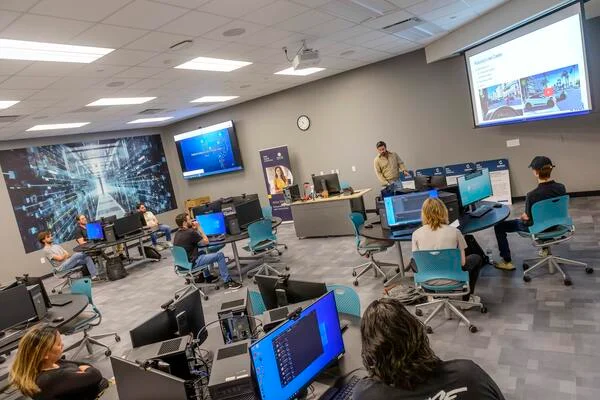
Students earning a bachelor’s degree in artificial intelligence at Chandler-Gilbert Community College attend class.
Maricopa Community Colleges
Now the California State University system and California Community Colleges are battling over a set of proposed baccalaureate programs that CSU flagged as duplicative. Sixteen proposed degrees are at issue, including seven first proposed in 2023.
For some of the programs, only one CSU campus has objected, whereas for others, “seven or eight CSUs have said, ‘When we look at the courses, the curriculum and the outcomes and what types of roles these are filling, these are absolutely duplicative of programs that we have,’” said Nathan Evans, associate vice chancellor of academic affairs for the CSU system.
But he also stressed that the two systems are trying to “work toward the same objective of creating access to postsecondary opportunities in California.”
Todd, of the California community college system, stands behind community colleges’ process for determining duplication, noting that colleges must submit “extensive documentation” demonstrating unmet workforce need and an analysis of how the proposed program compares to existing CSU and University of California offerings.
“Deliberative conversations” are underway with CSU representatives about the proposals in limbo, Todd said. “It would be premature to comment on the next steps until those conversations have concluded.”
This is a familiar pattern. In California, the community college and four-year systems have repeatedly duked it out over such proposals since a 2021 California law first allowed community colleges to stand up new baccalaureate degree programs. Under the law, community colleges can apply to offer up to 30 new four-year programs annually if the programs don’t replicate existing programs at state universities. That is evaluated in a review process with representatives of the California State University system and the University of California system, followed by approval from the California Community College system chancellor’s office.
Those reviews have grown so contentious that the community college system contracted the nonprofit WestEd last year to analyze possible duplication issues and ways to improve the review process with the CSU system. WestEd’s report, released last summer, concluded that the systems seem to be working with different definitions of “unnecessary duplication,” and while there is overlap between proposed and existing programs, CSU’s objections can be overly broad. Evans said CSU’s faculty concerns, and ways of defining duplication, weren’t appropriately factored into the WestEd study.
Legislation to introduce new types of community college baccalaureate degrees have also been a recent source of contention in the state. Governor Gavin Newsom vetoed a bill in 2024 that would have allowed community colleges to offer a bachelor of science in nursing, arguing that systems should be collaborating on nursing education and the bill could “inadvertently hurt” partnerships. More recent legislation that would allow Southwestern College to offer up to four more bachelor’s degrees—in applied forensic science, allied health education and leadership, teaching English to non-English speakers, and web design—has advanced to the California Senate, despite opposition from the CSU and UC systems.
The programs proposed in the bill are “designed to complement, not compete with, the four-year universities,” Todd said.
But Evans sees such bills as “problematic because they’re not thinking big picture,” he argued. “These are just sort of nibbling around the edges, creating friction” versus taking a more “wholesale” approach to student access and sorting out differences over community colleges’ four-year degrees.
Reaching Agreements
Despite these squabbles, some potential models for collaboration are emerging.
Brian Durham, executive director of the Illinois Community College Board, said he’s “hopeful” his state will adopt community college baccalaureate degrees soon, in part because the colleges “negotiated pretty extensively” with universities, which pushed back on legislation proposed last year.
A new agreed-upon version, which the board expects to see introduced this year, offers the universities multiple opportunities for input on new baccalaureate programs and puts limits on the number of nursing programs per region to avoid “too much competition,” Durham said. As a result, Illinois university leaders have since adopted a more neutral stance.
A statement from a coalition of public and private university leaders last year said that the group “will take no position on the merits” but acknowledged that “the shifting landscape of higher education, heightened uncertainty, and our commitment to our institutions and the students of Illinois require us to be vigilant and monitor the implementation of this proposal.”
Steinke, of the Iowa Association of Independent Colleges and Universities, said the guardrails put in place matter. He contended that the conversation in his state might have gone differently if Iowa community colleges and universities initially worked together to develop a set of unique programs that universities don’t cover.
Evans, of the CSU system, agreed there are ways to improve tensions between the two sectors. For example, representatives from both the CSU and California Community Colleges are exploring ways to communicate earlier about possible program duplications, rather than hash it out after colleges have already gone through the labor of drafting intensive proposals. Newsom’s administration is also working to set up a California Education Intersegmental Council to ensure better coordination between the state’s two-year and four-year higher ed systems.
Kersenbrock emphasized that universities are “a major resource for this country” and community college baccalaureate advocates “don’t want them to get hurt at all.”
Creating community college baccalaureate degrees “takes real, intentional work. It takes trust on everybody’s side. It takes assurances,” she said.
At the same time, she believes smaller, private four-year universities that attract out-of-state students may need to reckon with whether their programs serve the same state needs that community college programs do.
“I think you have to just ask those questions,” she said.
Durham said the growth of community college baccalaureates represents a broader blurring of the lines between higher education sectors right now. For example, dual-enrollment classes for high school students have rapidly expanded at community colleges, and four-year institutions are starting to offer more short-term programs.
“It reflects the changing landscape of education,” he said. “We are going to have to recognize that there’s some blend happening … and that’s a good thing. Ultimately, it’s about students.”