
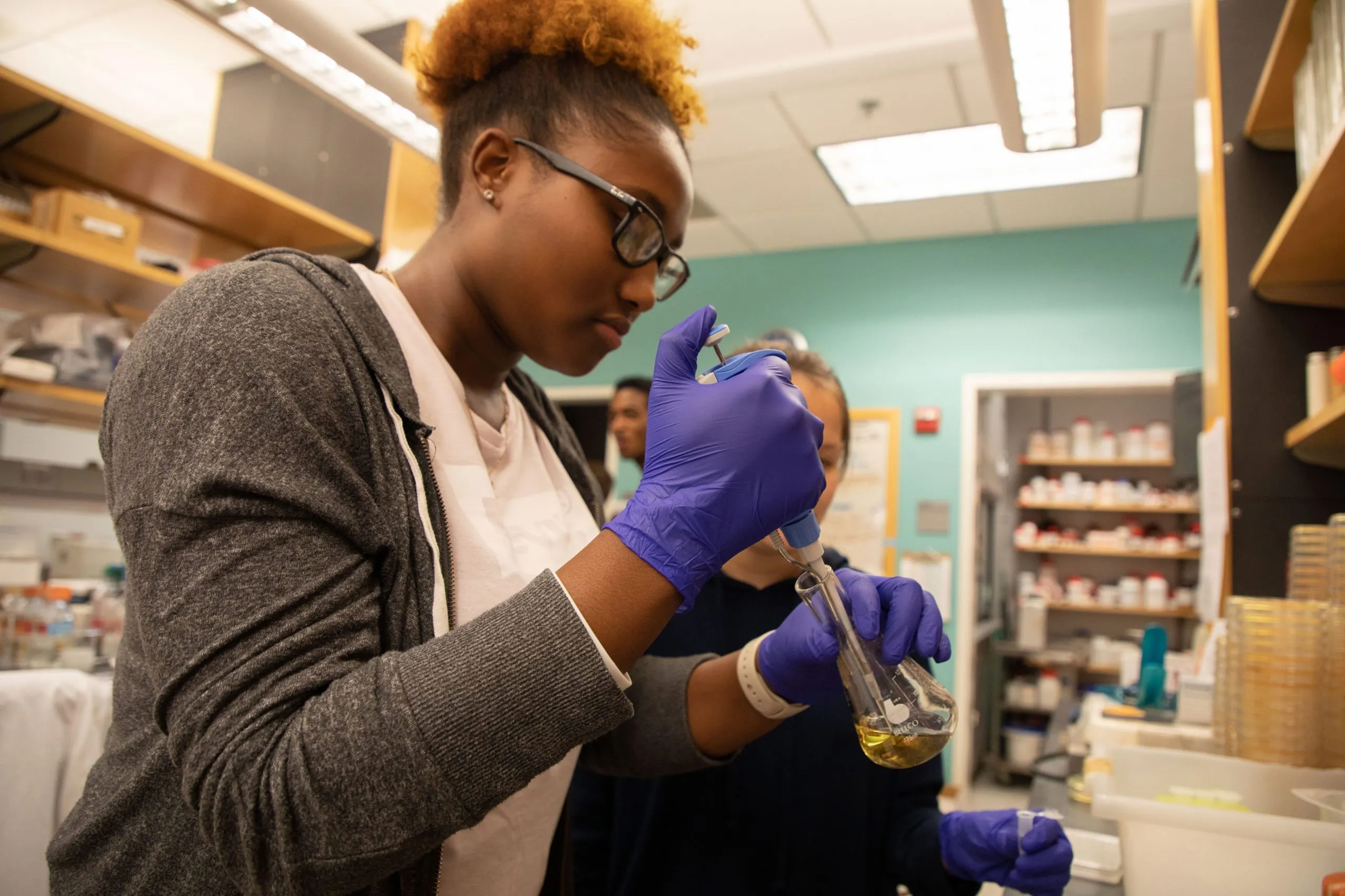
by JP Flores, The Hechinger Report
February 16, 2026
When I was 17, I didn’t know a single scientist. I did not grow up around labs, research universities or people who talked about things like “STEM pathways.”
The only reason I am a scientist today is because mentors leading support programs invested in me early, before I knew how to find science on my own. Today, those are the very programs being dismantled. Doors that opened for me and my colleagues are now being quietly shut for others.
Federal officials recently confirmed that research funding related to diversity, equity and inclusion at the National Institutes of Health will not be renewed, signaling a broader retreat from efforts designed to widen the pathway to participation in science. This comes as federal research funding faces billions in proposed cuts.
Outreach and diversity programs are also being defunded or restricted. More than 120 TRIO programs, which seek to provide support for students from disadvantaged backgrounds, have already been eliminated. Scientists and trainees across career stages are openly considering leaving the country for places where their work, training and the communities they serve will be better supported.
Related: Interested in innovations in higher education? Subscribe to our free biweekly higher education newsletter.
We are not simply shrinking budgets. We are shrinking who gets to imagine themselves in science at all.
Yet if we want a scientific workforce capable of addressing climate change, public health inequities and the next generation of biomedical challenges, we must invest in students long before they become scientists by supporting them early and building trust with communities, not just institutions. Investment should include expanding paid undergraduate research across community colleges, regional public universities, HBCUs and tribal colleges, and paying graduate students and postdocs wages that reflect the cost of living where they work.
For decades, efforts to broaden participation in science have relied on the metaphor of a pipeline: Encourage more students to enter STEM and trust that great candidates will progress into research careers. But this assumes a smooth and supportive path.
In reality, students encounter uneven terrain, not a pipeline. Curiosity and talent are not enough if the material conditions for growth are absent.
Programs like TRIO (including Upward Bound), the Louis Stokes Alliances for Minority Participation from the National Science Foundation (NSF) and the BUILD and Postbac Program initiatives from the National Institutes of Health (NIH) have provided critical academic, financial and mentorship support for the students who accessed them. Many of my peers credit these programs with their scientific careers.
A nutrition scientist at the University of Alabama, Birmingham credits the NIH BUILD program at California State University, Long Beach for exposing her to the world of research. A virologist at the University of Michigan credits the NIH PREP program at the University of North Carolina at Chapel Hill for her development as a scientist.
But these opportunities reach only a fraction of those who could benefit. Many internships and opportunities require unpaid participation, travel or preexisting access to higher education that students at under-resourced institutions do not have. By the time most of these programs begin, inequities are already deeply entrenched.
Consider this scenario: A community college student works 25 hours a week to pay rent and is offered only unpaid research experience. Meanwhile, a student at a well-funded university joins a lab with pay, mentorship and funded conference travel.
These differences shape who advances in science not because one student is more capable than another, but because one has access to the support systems that allow potential to develop into expertise.
This is not only about fairness, though the current trajectory is deeply unfair. It affects the science we produce. A scientist’s background influences which questions they consider important, the communities they feel accountable to and which problems are defined as urgent. Expanding who can participate in science strengthens the work rather than weakens it.
Talent and persistence matter in science. Curiosity, discipline and creativity are essential. But even the most gifted students cannot succeed without the material conditions that allow their abilities to grow.
Yet most federal research funding still arrives late in the scientific journey: graduate fellowships, postdoctoral awards and early career grants for those who have already managed to stay. By that point, many talented potential scientists have already been pushed out. I have watched peers with brilliance, creativity and purpose walk away because they could not afford to remain in science long enough to be recognized.
Related: To attract more students to STEM fields in college, advocates urge starting in sixth grade
Science needs a shift in how it engages with the public — not by asking for trust after the fact, but by building relationships early and consistently. We cannot continue to ask people to trust science if science rarely takes time to understand the needs, constraints and priorities of the communities it aims to serve.
This trust is essential because scientific breakthroughs do not only happen in laboratories and academic journals. They also emerge when researchers collaborate with educators, students and communities, shaping research questions alongside the people whose lives the work will ultimately affect.
Expanding who participates expands the questions we can ask. When scientific knowledge is grounded in lived experience and community partnership, science becomes more rigorous, more ethical and more relevant.
The talent exists. The curiosity exists. What is missing are the conditions that allow people to access scientific education early, remain supported and grow into scientific leadership.
These are not symbolic diversity efforts. They are strategies for producing better science.
JP Flores is a Ph.D. candidate in Bioinformatics and Computational Biology at the University of North Carolina at Chapel Hill, co-founder of the nonprofit Science for Good and a Public Voices Fellow on Technology in the Public Interest with The OpEd Project.
Contact the opinion editor at [email protected].
This story about research experience for college students was produced by The Hechinger Report, a nonprofit, independent news organization focused on inequality and innovation in education. Sign up for Hechinger’sweekly newsletter.
This <a target=”_blank” href=”https://hechingerreport.org/opinion-pathways-for-future-scientists-are-becoming-scarce-threatening-a-strong-and-innovative-workforce/”>article</a> first appeared on <a target=”_blank” href=”https://hechingerreport.org”>The Hechinger Report</a> and is republished here under a <a target=”_blank” href=”https://creativecommons.org/licenses/by-nc-nd/4.0/”>Creative Commons Attribution-NonCommercial-NoDerivatives 4.0 International License</a>.<img src=”https://i0.wp.com/hechingerreport.org/wp-content/uploads/2018/06/cropped-favicon.jpg?fit=150%2C150&ssl=1″ style=”width:1em;height:1em;margin-left:10px;”>
<img id=”republication-tracker-tool-source” src=”https://hechingerreport.org/?republication-pixel=true&post=114826&ga4=G-03KPHXDF3H” style=”width:1px;height:1px;”><script> PARSELY = { autotrack: false, onload: function() { PARSELY.beacon.trackPageView({ url: “https://hechingerreport.org/opinion-pathways-for-future-scientists-are-becoming-scarce-threatening-a-strong-and-innovative-workforce/”, urlref: window.location.href }); } } </script> <script id=”parsely-cfg” src=”//cdn.parsely.com/keys/hechingerreport.org/p.js”></script>